Welcome. This is a new series where I am reading The Psychology of Money chapter by chapter and giving you my thoughts on it. This isn’t purely a summary or a guide to the book, but an attempt to wrestle with the ideas honestly—where they hold, where they strain, and what they reveal about how people actually behave around money.
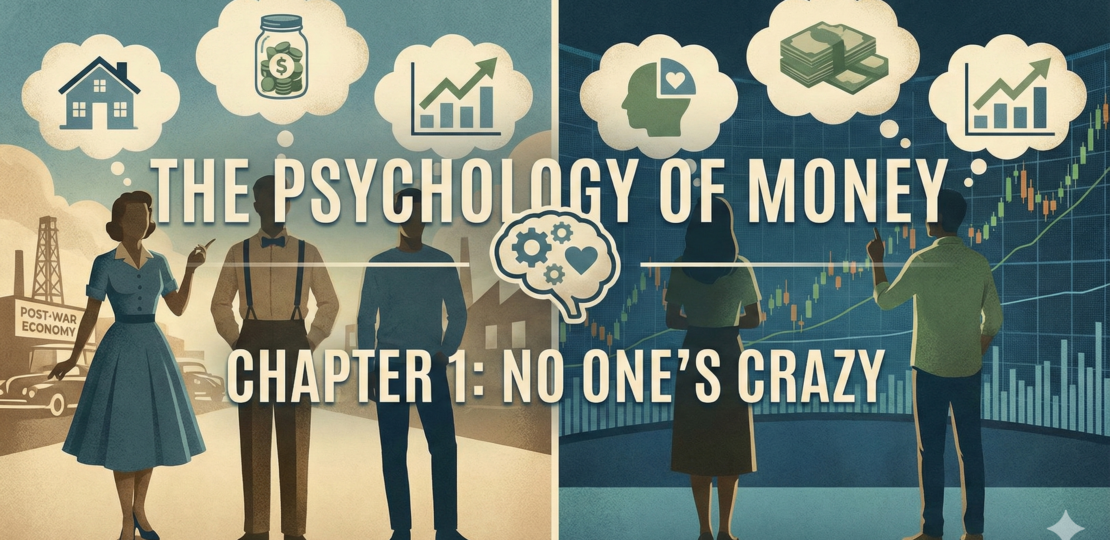
Chapter 1: No One’s Crazy
Money decisions are often judged as if they emerge from pure logic, but that assumption collapses once experience enters the picture. Each person’s financial worldview is built from a vanishingly small slice of history, yet it accounts for most of how they believe money works. This is why people facing the same data can reach wildly different conclusions. It isn’t ignorance at play so much as memory. What you lived through quietly outweighs what you were taught.
Models and spreadsheets capture outcomes, not the emotional residue attached to them. They cannot reproduce fear learned during instability or confidence bred during long periods of growth. Research on investor behavior shows that people carry the economic conditions of their early adulthood forward for decades, shaping their tolerance for risk more than formal education ever could. Financial “wisdom,” then, is often situational. What worked brilliantly in one era can look misguided in another.
This lens helps explain behavior that is commonly dismissed as irrational, such as prioritizing lottery tickets over emergency savings. Financially, the harm is obvious. Emotionally, the logic is clearer: it is the purchase of hope in a system where progress feels out of reach. But understanding motivation should not slide into justification. Emotional reasoning can explain why a decision is made without making it defensible. Treating feelings as a shield risks preserving the very behaviors that cause harm.
Saving and investing are often treated as ancient instincts, when in reality they are relatively new social practices. Expecting universal mastery ignores how little time humans have had to adapt to abstract, delayed rewards at this scale. Experience explains financial behavior—but it does not excuse its consequences. Clear thinking about money begins when empathy sharpens judgment rather than replaces it.
Note: I have specifically not included any direct example or quote from the book for two reasons.
A. I don’t want to be accused of plagiarism.
B. These posts are the online public copy of my thoughts, not Morgan Housel’s thoughts.
RELATED POSTS
View all