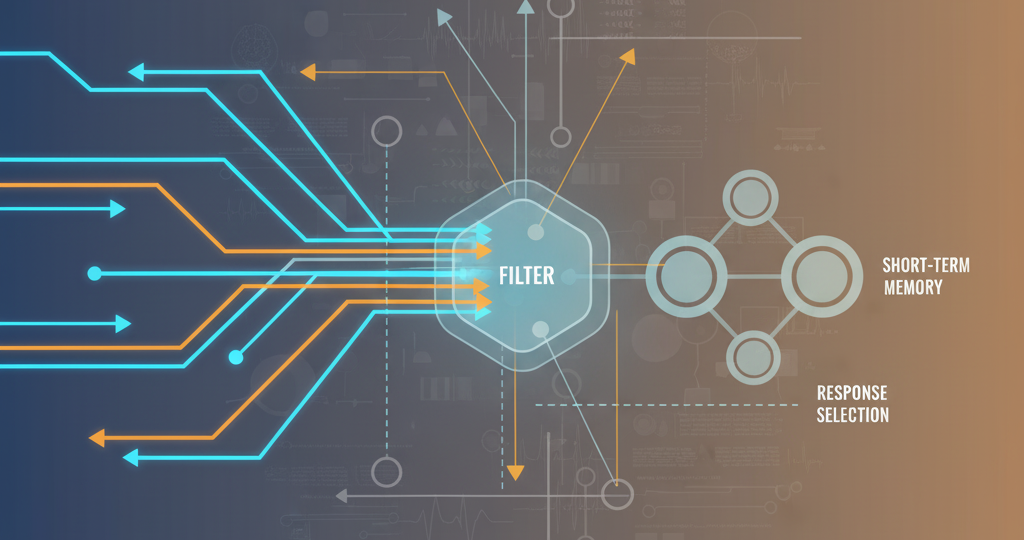
Attention span is a huge problem nowadays (me included). Although this man didn’t exactly talk about attention span specifically, he is one of the most important figures in the attention research field. Donald Broadbent, a British experimental psychologist, revolutionized cognitive psychology through his groundbreaking studies on selective attention. His most influential work, the Filter Model of Attention (1958), proposed that humans process information through a limited-capacity system that filters sensory input, allowing only relevant data to reach conscious awareness.
Broadbent’s experiments—many inspired by wartime challenges of air traffic communication—showed how people could focus on one message among several simultaneous inputs. His “dichotic listening” studies, where participants received different audio messages in each ear, revealed how attention acts like a bottleneck, filtering based on physical characteristics before meaning is processed.
This model became a cornerstone of cognitive psychology, influencing later theories by Anne Treisman and Daniel Kahneman that refined our understanding of perception and multitasking. Beyond theory, Broadbent’s work shaped human factors engineering, improving cockpit design, communication systems, and even modern user-interface research.
Broadbent’s insight—that attention is both a filter and a gatekeeper of cognition—remains one of psychology’s most enduring contributions, bridging experimental science and real-world human performance.
RELATED POSTS
View all