

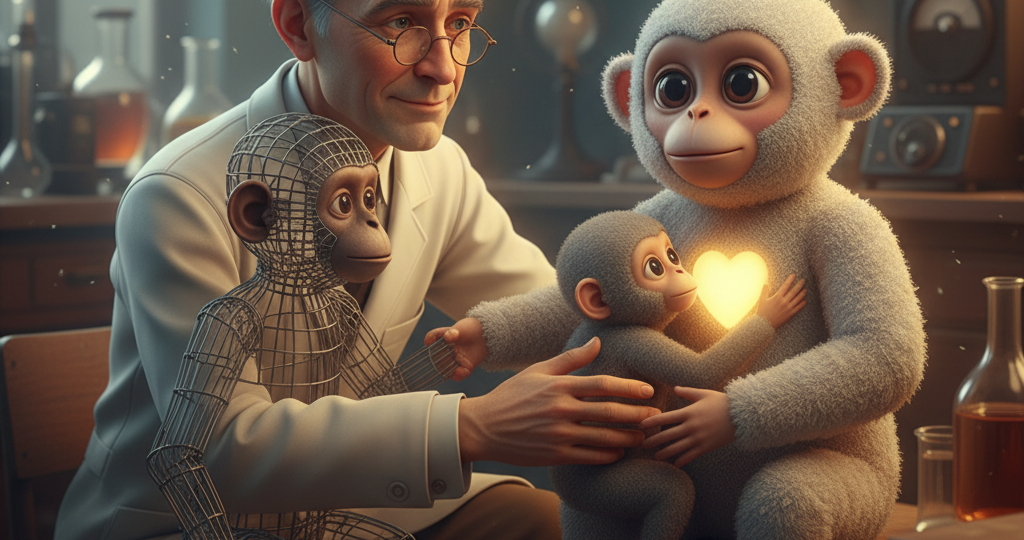
When most psychologists were focused on cognitive tasks or conditioning in the mid-20th century, Harry Harlow turned his attention to something far more fundamental: the emotional lives of primates — and by extension, humans. His experiments on attachment and affection reshaped how we understand the bonds between parents and children.
Harlow is best known for his work with infant rhesus monkeys in the 1950s and 60s. He presented them with two surrogate “mothers”: one made of wire that provided food, and another soft, cloth-covered figure that offered no nourishment. Surprisingly, the monkeys spent far more time clinging to the soft mother, seeking comfort over sustenance. This revealed that contact comfort — the simple, tactile reassurance of closeness — was a critical component of healthy emotional development.
Harlow’s research extended to social deprivation experiments, showing that monkeys isolated from maternal contact exhibited severe social and emotional deficits later in life. His work highlighted the essential role of love, comfort, and social interaction in development, influencing not only psychology but also childcare practices and adoption policies worldwide.
Though controversial and ethically challenging by today’s standards, Harry Harlow’s studies taught a timeless lesson: emotional bonds aren’t luxuries — they are vital to growth, learning, and survival.
RELATED POSTS
View all


The Science of Recognition: How Repetition Shapes Consumer Choice
June 3, 2026 | by Venkat Balaji


Status Quo Bias: Why We Resist Change Even When It’s for the Better
March 6, 2025 | by Venkat Balaji