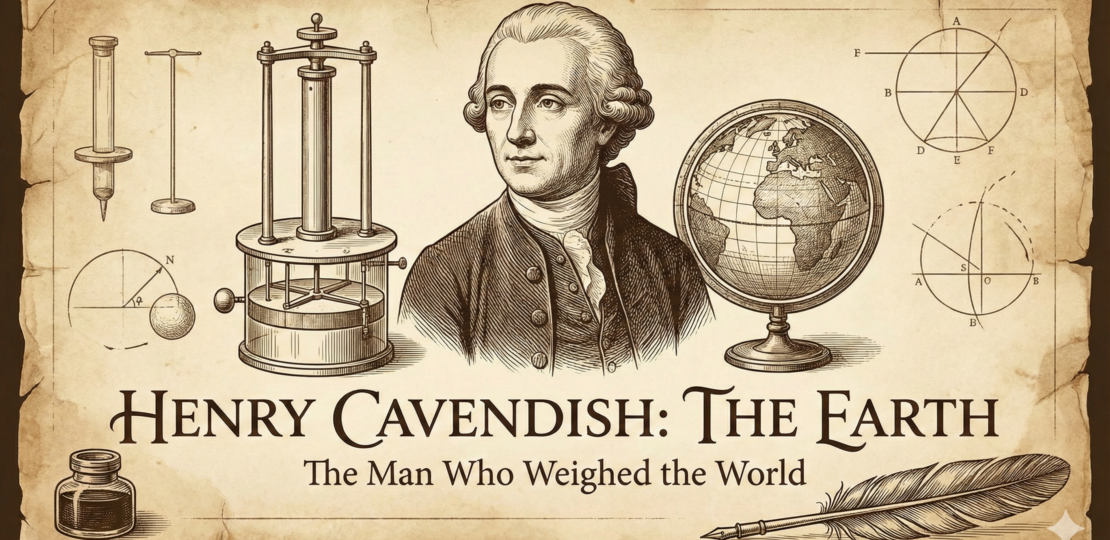
There’s a delightful charm in watching someone get obsessed with a single idea—especially when that idea is “how heavy is this thing, really?” One physicist who dove into that rabbit hole with gusto was Henry Cavendish, a man so shy he’d rather leave answers on the table than talk to actual people. Yet he became the first person to measure the weight of the Earth. Not a mountain. Not a continent. The entire planet. That’s one way to avoid small talk.
Cavendish lived in a time when weighing anything beyond your groceries was considered ambitious. But he wanted to know Earth’s density—how much mass was packed inside our rocky home. Without satellites, lasers, or anything remotely modern, he set up a delicate torsion balance: two small lead balls suspended on a wire, and two enormous lead balls placed nearby. As the tiny attraction between them tugged on the wire, the whole setup gently twisted. This was gravity whispering instead of shouting. Cavendish listened.
By measuring how much the wire twisted, Cavendish could calculate the gravitational force between the balls. From that, he inferred Earth’s mass. The result? Impressively accurate. And all from a contraption that could’ve doubled as a Victorian art installation. What makes Cavendish lovable isn’t just the quiet genius but the sheer weirdness of the task. Who wakes up and says, “I will weigh the planet today”? Someone who can’t be bothered by distractions like conversation or fame.
In a way, Cavendish proved that patience, precision, and a bit of eccentricity can open the door to extraordinarily big answers. You don’t need rockets to uncover cosmic truths—you can do it in a small shed with some lead balls and a string, provided you don’t mind waiting for the wire to stop wobbling. Physics is often loud and explosive, but sometimes the biggest discoveries come from the gentlest of nudges.
RELATED POSTS
View all