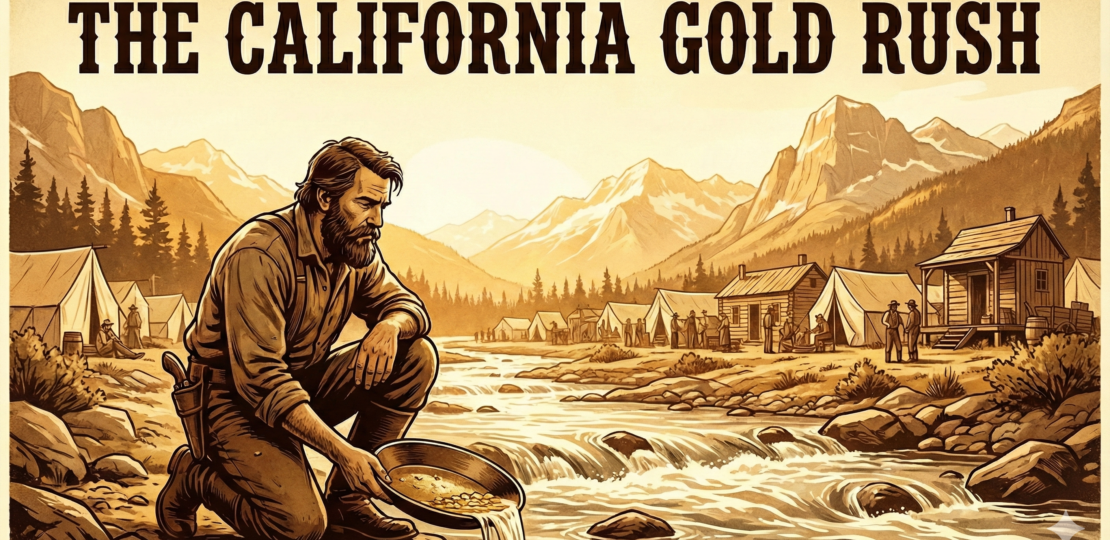
Imagine waking up one morning to find that your everyday river has turned into a glitter factory. That’s basically what happened in 1848 when workers at Sutter’s Mill in California stumbled upon gold. Word leaked out—because secrets involving gold last about as long as soap bubbles—and suddenly the world sprinted toward California with shovels, dreams, and questionable hygiene.
The California Gold Rush wasn’t just an American treasure hunt. It triggered one of the biggest monetary shocks of the 19th century. Back then, most major economies operated on a gold or bimetallic standard, meaning the supply of gold literally influenced how much money existed. So when hundreds of thousands of prospectors yanked gold out of the ground at astonishing speed, the global supply of money ballooned.
More gold meant more coins. More coins meant easier credit. Easier credit meant more buying, building, importing, expanding. Consumer prices nudged upward, international trade loosened, and countries previously stuck in sluggish economies suddenly felt caffeinated. It was an inflationary jolt on a global scale—like the world economy got a surprise espresso shot.
Economists now see the Gold Rush as one of the earliest examples of a commodity-driven monetary expansion. It showed just how vulnerable economies were to natural resource discoveries. When the money supply depends on whatever someone might dig up, well…you’re living inside a financial slot machine. Spain had discovered this the hard way in the 1500s. The 1800s simply replayed the lesson with better hats.
The Gold Rush also led to ripple effects you might not expect. More money and more trade put pressure on nations to formalize consistent monetary systems. It encouraged migration on a scale unprecedented at the time. It even reshaped wealth distribution—some people struck it rich, most struck rocks, and merchants selling shovels made out like royalty.
What makes this phenomenon fascinating is how accidental it was. No policymaker planned it. No economist predicted it. The global economy was rewritten by men with pans, rivers that glittered, and the stubborn human belief that the next scoop of dirt might be worth a lifetime of dreams.
RELATED POSTS
View all