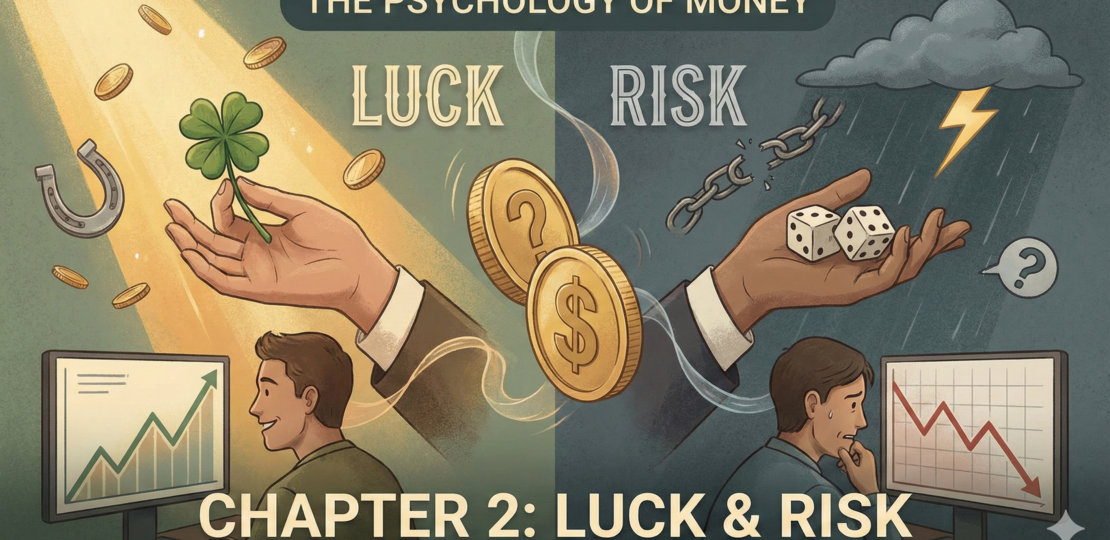
Welcome back. This is chapter 2 of the Psychology of Money. It talks about luck and risk in the world of finance, although many principles can be applied to many other aspects of life. One of my favorite chapters.
Chapter 2: Luck & Risk
Most explanations of success assume a neat relationship between effort and outcome. In reality, that balance shifts constantly depending on context. Effort matters, but so does timing, access, and chance exposure to the right environment. The problem isn’t recognizing luck; it’s pretending we can assign it a fixed percentage. In some situations, effort dominates. In others, luck quietly does most of the heavy lifting. The mistake is treating one formula as universal.
This tension becomes obvious when we turn people into lessons. Extreme success stories are compelling precisely because they are rare, but that rarity also makes them dangerous templates. Figures like Bill Gates can be admired without being copied. Talent and discipline played a role in his success, but so did circumstances that cannot be replicated at will. Gates himself captured this risk when he noted, “Success is a lousy teacher. It seduces smart people into thinking they can’t lose.” The lesson is not that success is undeserved, but that it is often overinterpreted.
Failure suffers from the opposite distortion. Other people’s losses are easily attributed to poor judgment, while our own setbacks are explained through bad breaks or unfortunate timing. Neither view is complete. Risk is real, but so are bad decisions, and separating the two is harder than we like to admit. Leaning too heavily on luck absolves responsibility; ignoring it creates false certainty.
Taking luck and risk seriously doesn’t lead to cynicism, but to restraint. Outcomes are rarely as instructive as they appear. Studying patterns across many lives is more reliable than dissecting a few extraordinary ones. Effort still matters—but it operates inside a world that refuses to be fair, predictable, or repeatable on demand.
RELATED POSTS
View all