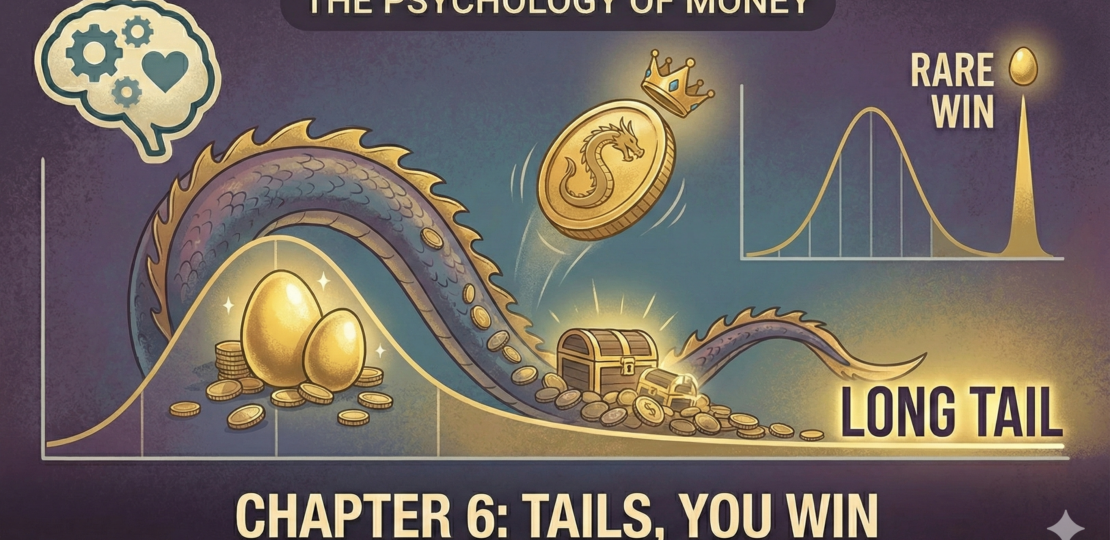
Welcome back. This is chapter 6 of the Psychology of Money. It really delves into the details of how a small percent makes most of the difference. It is on the lines of the Pareto Principle, but as you will see, it is way lower than 80-20.
Chapter 6: Tails, You Win
Our instincts resist this idea because we expect success to track accuracy. In reality, outcomes often hinge on a small number of extreme events. A few decisions at the far ends of probability distributions—the tails—account for a disproportionate share of results. This is true across investing, business, and creative work. Walt Disney produced hundreds of hours of content, but it was a single project that altered the trajectory of his company. Most effort didn’t fail; it just didn’t matter much.
What makes this difficult to accept is not the math, but the emotional implication. Being wrong frequently feels like incompetence, when it may simply be the cost of operating in a world driven by uneven outcomes. Venture capital data makes this explicit: most bets lose money, a small fraction do extremely well, and an even smaller fraction account for nearly all returns. Accuracy is not the goal. Exposure is.
This pattern appears even in places that feel stable and respectable. Broad stock indices derive most of their gains from a small minority of companies. Many others decline permanently without drama or scandal. Success, then, is less about consistently identifying winners and more about staying involved long enough for a few rare outcomes to dominate. This reframes what “being good” actually means.
The psychological challenge is composure. Napoleon defined a military genius as “the man who can do the average thing when all those around him are going crazy.” That definition fits neatly here. In environments ruled by tails, restraint and patience often outperform brilliance. Peter Lynch’s admission that being right six times out of ten qualifies as exceptional underscores the same point: perfection was never the requirement.
Seen this way, the presence of tails isn’t discouraging. It’s clarifying. It asks for intellectual humility—a recognition that randomness shapes outcomes more than intuition suggests, but not so much that effort becomes irrelevant. Being wrong is not a verdict. It’s a normal feature of systems where a few outcomes matter far more than the rest.
RELATED POSTS
View all