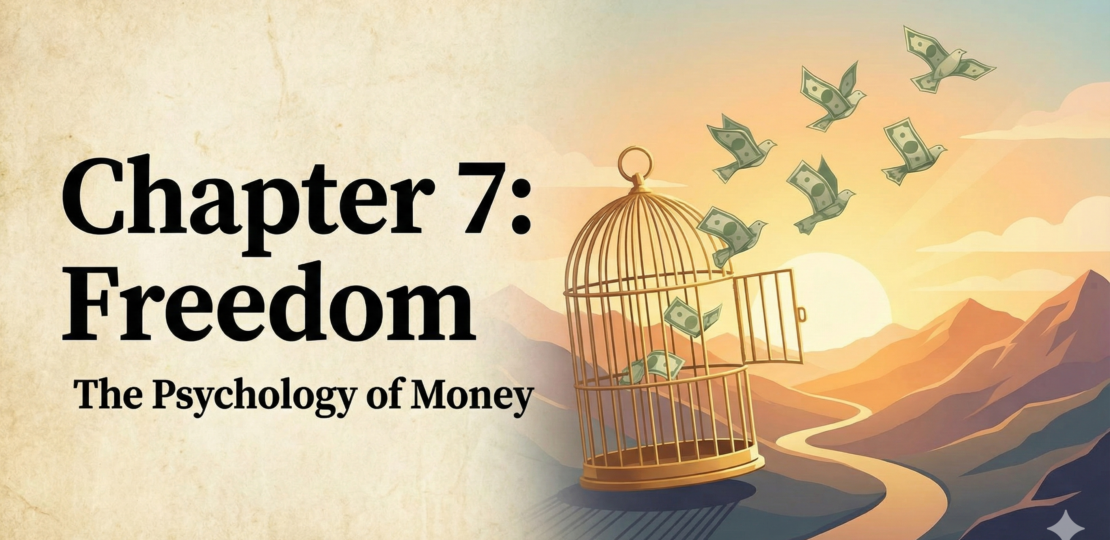
Welcome back. This is chapter 7 of the Psychology of Money. It is one of the most important chapters, and definitely my favorite.
Chapter 7: Freedom
Time itself is freedom. Not how efficiently it’s used, not whether it’s spent learning, earning, or even wasting—but the simple fact that it belongs to you. Money does not manufacture happiness; it removes friction. Its real contribution is giving you ownership over your hours. What you choose to do with those hours is a separate, deeply personal responsibility.
Happiness may be subjective, but the desire for control is not. Human beings are built for choice. The ability to think, to feel, to decide is fundamental, not optional. This is why control over one’s life shows up so consistently in discussions of wellbeing. A difficult life that you choose feels lighter than an easier life that is imposed.
Material wealth does contribute to happiness—up to a point. Owning things you value, living comfortably, and reducing daily stress all matter. The problem isn’t material ambition itself; it’s when the goalpost keeps moving. As income rises, commitments tend to rise with it. At some stage, possessions stop serving freedom and start demanding it. What once felt like progress becomes maintenance.
Debt fits into this more subtly than people admit. Debt is not inherently bad. Used carefully, it can accelerate progress and widen opportunity. Used carelessly, it does the opposite. The issue is not whether debt exists, but whether it limits your ability to choose. When obligations begin to dictate your decisions, freedom quietly erodes.
Money’s true power lies in options. Even the option to do nothing has value. Options reduce desperation. They allow you to walk away from situations that are misaligned with your values or damaging to your mental health. This is why financial buffers matter so much. They don’t just protect against emergencies; they protect self-respect.
Early retirement is often misunderstood as an escape from work. It’s better understood as an escape from compulsory work. The goal isn’t inactivity, but alignment—being able to spend your days on pursuits that feel meaningful rather than necessary. The deepest appeal of financial independence is not leisure; it’s the absence of a boss.
Human beings naturally resist being controlled. When authority is imposed, something in us pushes back. This resistance isn’t immaturity; it’s psychological self-preservation. Those who never resist often drift into comfortable compliance, not because they lack ability, but because they never defend their autonomy. Freedom sharpens judgment. Constant obedience dulls it.
Modern society is wealthier than ever, yet anxiety and stress remain stubbornly high. Bigger homes, better technology, more convenience—and still a sense of being rushed and constrained. Part of the reason is that work no longer ends. When labor was physical, it was confined to a place. Now it is cognitive, and it follows us everywhere. The modern factory is not a building; it is the day itself.
Freedom today requires intention. Technology can serve us, but only if we refuse to let it define us. It should be a tool that enables work and pleasure, not an obligation that fills every waking moment.
In the end, freedom is not a single achievement. It is a balance between time, choice, and inner calm. Lose one, and the others weaken. Protect them together, and money finally does what it was meant to do: step back and let life take the lead.
One uncomfortable truth we have to live with is: we traded freedom for comfort without noticing the exchange rate.
RELATED POSTS
View all

The Anticipation Engine Part 1: Inside the Reward System
May 20, 2026 | by Venkat Balaji
Feeling Good is much more than a mood enhancement: The Broaden-and-Build Theory
January 9, 2026 | by Venkat Balaji