Welcome back. This is chapter 12 of the Psychology of Money. It expands on tail events, and goes into the world of uncertainty.
Chapter 12: Surprise
A large part of how the world moves can be explained by uneven contribution. A very small number of people account for a very large share of outcomes. This isn’t a motivational idea; it’s an observation. Those few exert outsized force, and history records their effects disproportionately. The mistake is assuming this distribution implies obligation—that everyone should try to be one of them. Force existing does not mean it must be personally pursued.
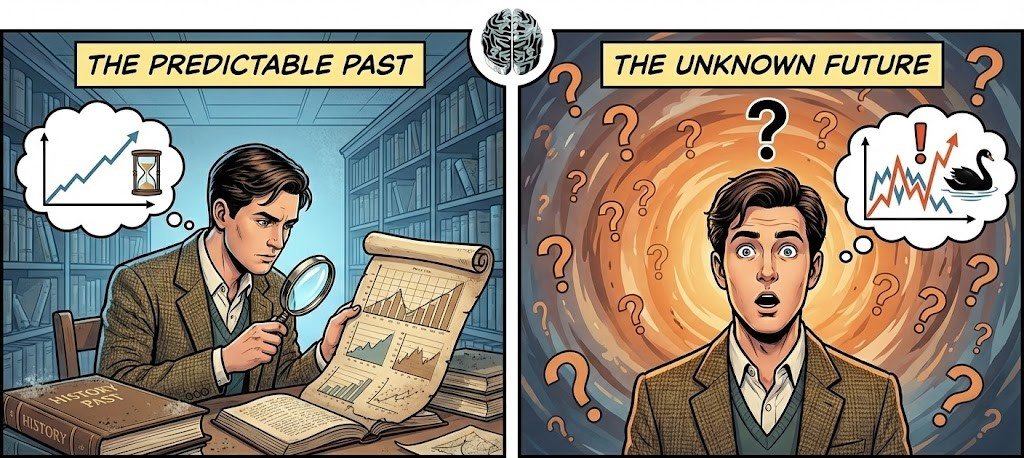
History, on its own, is incomplete. Without imagination, it becomes a catalogue rather than a guide. The past is not useless, but it is often misused. It functions more like a compass than a map, and even then, it needs constant tuning. Patterns recur, but conditions never repeat cleanly. Reading history without adjusting for context creates confidence without accuracy.
Surprises expose the limits of preparation. By definition, they arrive from angles we didn’t defend against. Holding the fort against uncertainty is possible, but it is extraordinarily difficult and costly. The more complex the system, the more surface area it offers to the unexpected. Surprise isn’t a failure of intelligence; it’s a feature of reality.
This is why uncertainty feels so unsettling. It breaks the assumed relationship between effort and outcome. Humans are comfortable optimizing when the rules are stable. When outcomes detach from inputs, anxiety fills the gap. Peace of mind, then, often comes not from eliminating uncertainty, but from restricting how much exposure one chooses to tolerate.
Counterfactual history makes this even messier. We rarely know how replaceable an individual truly is. In some contexts, outcomes are highly substitutable—if one person hadn’t acted, another likely would have. In other contexts, a single imagination shifts the trajectory because alternatives were sparse or nonexistent. How different history would have been depends entirely on the density of competitors, the maturity of ideas, and the constraints of the moment. Broad claims fail here; only case-by-case analysis holds.
RELATED POSTS
View all