First things first, Happy New Year.
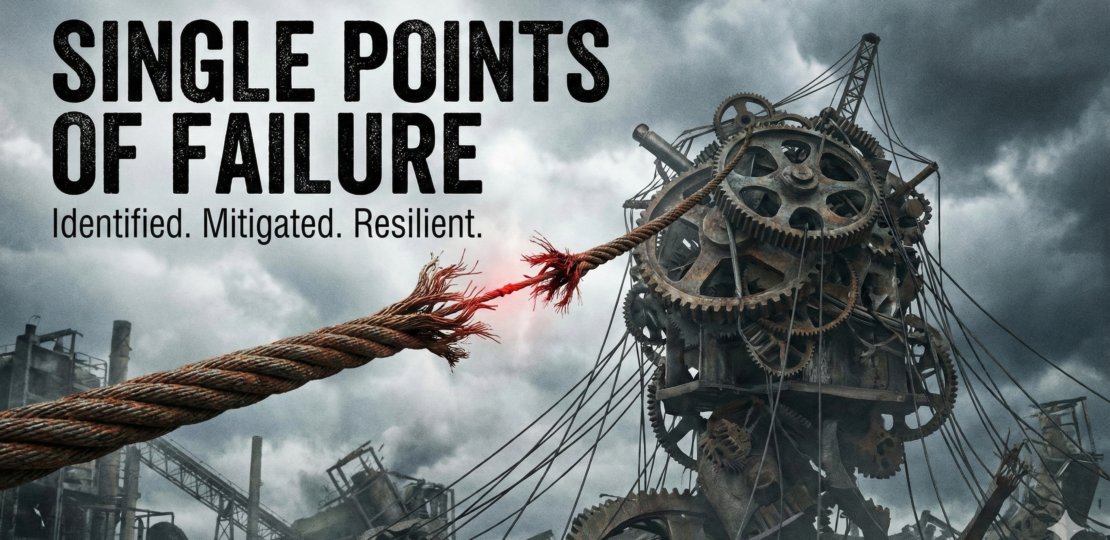
A single point of failure is deceptively self-explanatory: when one thing goes wrong, entire systems fall into the abyss. They usually reveal themselves when one component of a system is bearing a disproportionate share of the load. When you’re dependent on one component to deliver those loads, if it just so happens to malfunction, the entire load shuts down. All progress wiped out in a matter of seconds. This pattern shows up everywhere, from the depths of economics to the heights of technology.
Take a server, for instance. It handles multiple user requests, sometimes an entire project. When that is the case, if that one server shuts down, requests bottleneck immediately and the website will almost certainly shut down until the server comes back up. When multiple functions rely on one component without an alternative route, that system is fragile by design.
Evolution has done us a great favor in that sense. Our biology is designed around redundancy. Take a simple, everyday example. When you get a cold, and one nostril is filled with mucus and clogged, you still breathe through the other nose and maintain adequate oxygen supply to live daily life. Of course, you need to get the other nose fixed, but the system doesn’t shut down even if you don’t resolve it immediately. It will stabilize with the other nose. We do it in so many ways. We have two kidneys, two lungs and two eyes. Evolution has quietly learnt that single points of failure are one way tickets to extinction.
This is especially dangerous in economics. We saw this play out only recently. During Covid 19, critical supply chains were cut off, almost instantly making essential resources scarce in the most desperate times. What had long been considered prosperous and efficient completely collapsed when one domino in the chain tips over. COVID taught us a lot of lessons, including the ones that industries realized in the hard way.
So how does this affect you personally? Because relying on one skill for income, one habit for stability, one method for learning is functionally no different from a single all-encompassing server. It is a fragile system, and in the best case scenario, it will not falter. However, if it does, and it very well might, everything surrounding that aspect of your life comes crashing down, and spills over to other aspects of your life. I’m not trying to sound pessimistic; I’m simply asking you to consider identifying and eliminating single points of failure. While you can’t always predict the future, and unexpected things will be thrown at you, you can restrict the number of ways your life can slip, and this is one of the easiest risks to design against.
RELATED POSTS
View all