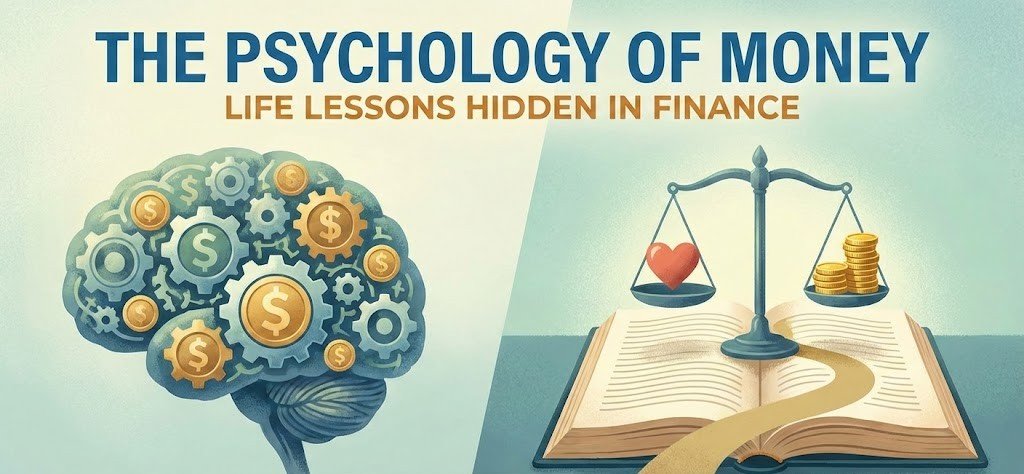
The Psychology of Money was a strange reading experience. When I first approached it like any other self-help book and attempted to read it in long, uninterrupted stretches, I failed to get past the halfway mark—twice. On my third attempt, I imposed a strict rule: one chapter a day. Under that constraint, the book turned out to be genuinely life-changing.
I hesitate to use the phrase “life-changing,” because it often feels exaggerated—or, in modern parlance, cheesy. Here’s the thing though: The Psychology of Money almost guarantees a shift in how you think—not just about money, but about life itself.
That took me by surprise. I expected novel strategies for managing money; instead, I encountered a set of life principles that reshaped how I think about nearly everything—most notably my approach to finance and career. This is where I believe the book’s marketing undersells it. The ideas and stories Morgan Housel presents apply seamlessly to career decisions and long-term life planning, yet few people seeking that kind of guidance would instinctively browse the finance shelf and pick up The Psychology of Money.
The book is divided into 20 chapters, but I like to further break it down into 3 sections:Understand, Learn, Realize.
The first five chapters focus on how people actually relate to money, and what truly matters for long-term wealth accumulation. You understand why people below the poverty line buy lottery tickets.They are not investing in a probability; they are investing in a dream.. Same goes with people that are too obese.They might resort to crash dieting. To others, it’s stupidity. To them, it represents an escape. Similarly, you begin to grasp the role of luck and risk across an investing lifetime—and, more importantly, you understand that survival, not intelligence, determines how far wealth can grow.
The next eight chapters are centered on learning—on absorbing principles rather than tactics.. You learn that saving doesn’t need an end goal; you can save for the sake of saving. You learn the greatest dividend money ever pays is time. Now I know that might seem on the side of understanding, but when you read the book, there is a fine line between what the first 5 chapters do and and these chapters do. The distinction lies in internalization rather than exposure. One of the best chapters of this book talks about being reasonable rather than rational. This is among the most valuable pieces of financial advice I’ve encountered—and it was entirely new to me. No other finance book I’ve read talks about this. Again, this doesn’t just apply to money.A student who time-blocks every minute of the day and plans to study six hours straight may be rational, but profoundly unreasonable. It’s not just the fact that it’s impossible to do (which it is; distractions exist everywhere), but also the downstream burnout is rarely worth the marginal gains of the study session. That sounds awfully simple, but it perfectly illustrates how this book delivers guidance on living, not merely on managing money.
The next 5 chapters are about realization. This section has some of the best perspective shifts you need to succeed in anything. The first of them: understanding that you will change. Nobody understands this, and it’s too late when you learn it. Once this is internalized, flexibility ceases to look like weakness and starts to resemble wisdom.. The second important realization: when one’s desperate enough, they’ll believe anything. History offers grim examples—people once believed diseases could be “burned” out of the body. That, right now, feels dumb but when medical understanding was primitive and a child was visibly deteriorating, desperation made any solution feel plausible. The same goes with money. When financial stress becomes severe enough, people will abandon reason in pursuit of normalcy. One more realization that I think is profound: Don’t try to imitate a person playing a different game. We do this way too often. We look at Buffett and other legendary investors and attempt to replicate their outcomes. Two things we fail to realize: first, you cannot invest the way they did because the conditions—and scale—are no longer the same. Second, their objectives are fundamentally different from yours, and imitation quietly pulls you away from your own goals. A person generating 18–20% returns may be chasing short-term gains, and while that appears impressive, if your objective is early retirement through long-term compounding, that strategy may actively undermine it.
In conclusion, this book is an easy recommendation. As I mentioned at the start, this book is not a race, but a marathon. The ideas are dense. Housel has a rare talent for expressing them with clarity, but their density remains. Another aspect to note is the book’s greatest strength lies in its storytelling. Housel doesn’t rely solely on research to validate his arguments; he relies on narrative. Those stories establish credibility in a way raw data rarely can. To sum up, anyone seeking genuine self-help—not just financial advice—can pick up this book and walk away having learned something meaningful about life. Morgan Housel has produced something rare: a finance book that quietly teaches wisdom.
RELATED POSTS
View all