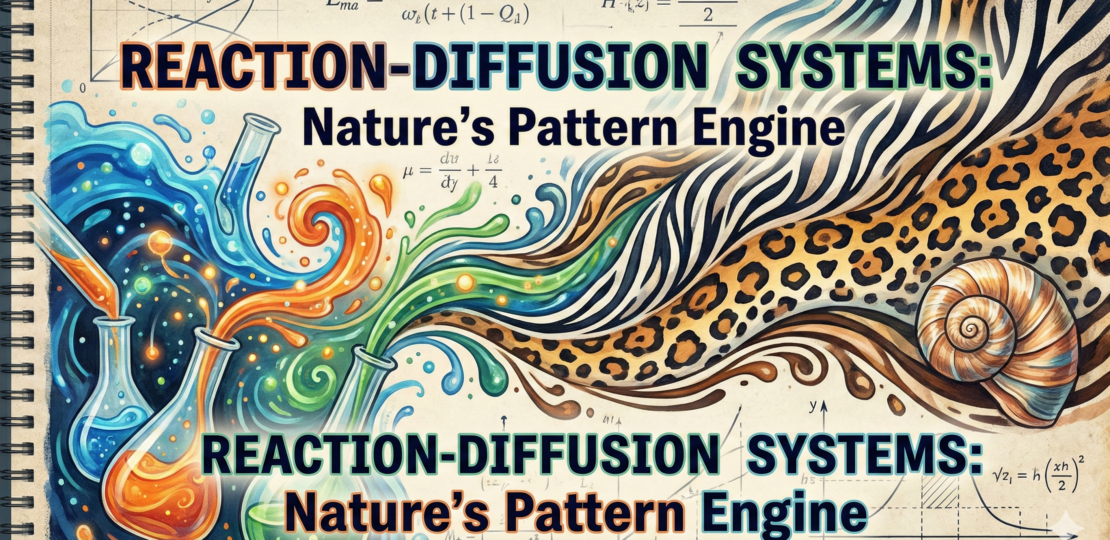
Some patterns feel designed. Zebra stripes. Leopard spots. The rippling bands on tropical fish. For a long time, biologists assumed there had to be a genetic blueprint for each stripe and dot, a microscopic painter carefully following instructions. Then came a more unsettling idea: maybe nature isn’t drawing at all. Maybe it’s just letting chemistry run.
In 1952, Alan Turing—yes, the computing pioneer—proposed something called a reaction–diffusion system. The idea is deceptively simple. Imagine two chemical substances spread across a surface. One reacts to produce more of itself and the other inhibits that growth. At the same time, both chemicals diffuse, spreading out over space. Where reaction and diffusion compete just right, stable patterns emerge. No plan. No overseer. Just equations arguing with each other until stripes happen.
What’s unsettling is how little information is required. You don’t need a “stripe gene” or a “spot instruction.” You only need local rules: amplify here, suppress there, spread everywhere. Out of this minimal logic, complex order appears. It’s a recurring theme in science—the universe seems oddly fond of doing more with less. Snowflakes, sand dunes, galaxies, and now animal coats all echo this principle.
Reaction–diffusion isn’t just biological poetry. Similar mathematics shows up in chemical oscillations, forest fire modeling, and even urban growth patterns. Cities, in a way, “diffuse” people and “react” through economic incentives. The equations don’t care whether they’re shaping fur or finance; they only care about rates, thresholds, and feedback.
There’s something quietly humbling here. The beauty we admire in nature may not be the result of careful design but of inevitable consequences. Given time, space, and a few simple rules, the universe tends to decorate itself. Patterns aren’t exceptions. They’re what happens when matter is left alone long enough to think.
RELATED POSTS
View all