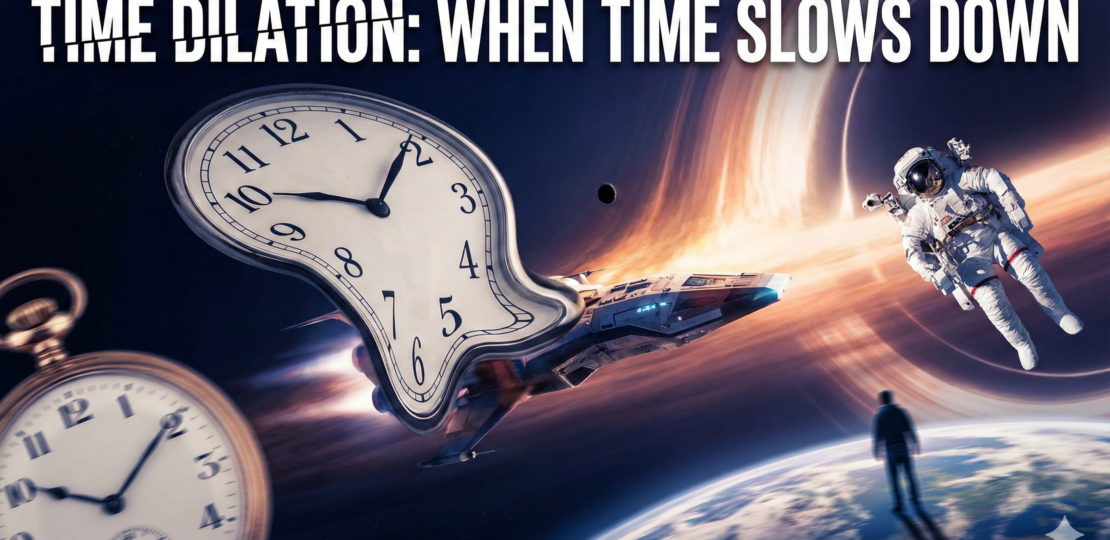
Time feels absolute when you’re waiting for an elevator. Seconds drag, stubborn and unmoving. Physics, however, treats time with far less respect. According to Einstein’s theory of relativity, time is flexible. It stretches, shrinks, and misbehaves depending on how fast you’re moving and how close you are to massive objects.
This effect, called time dilation, means that a fast-moving clock ticks more slowly than a stationary one. If an astronaut zooms through space at a significant fraction of the speed of light and returns home, they will have aged less than the people who stayed behind. This isn’t science fiction. It’s been measured. Atomic clocks on airplanes run slightly slower than those on the ground. GPS satellites must constantly correct for this effect or your phone would think you’re somewhere else entirely.
Gravity bends time too. Near a massive object, like a planet or a black hole, time crawls. Farther away, it speeds up. Your feet, being closer to Earth’s center than your head, are aging more slowly by a tiny fraction of a second. The difference is negligible for humans but crucial for precision technology. Time, like space, has a shape.
The deeper idea is unsettling: there is no single, universal “now.” Each observer carries their own clock, their own slice of reality. The universe does not agree on the present moment. It only agrees on relationships—how events line up relative to one another.
Time dilation strips away the comfort of a shared cosmic rhythm. What remains is stranger and more elegant. Time is not the stage on which physics happens. It is one of the actors, responsive to motion and mass, quietly reshaping reality while we argue with elevators about being late.
RELATED POSTS
View all