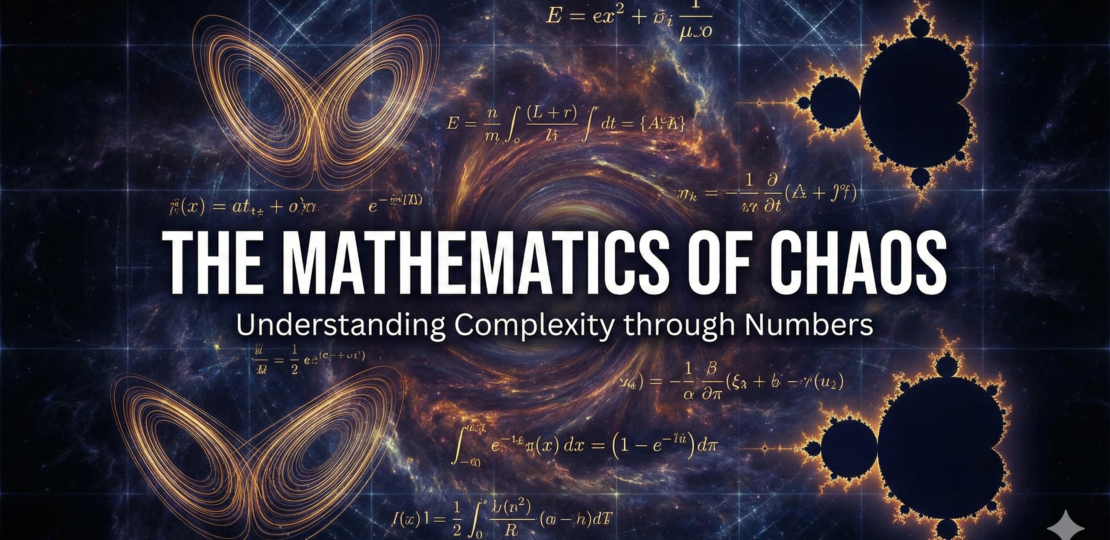
Chaos sounds like noise, randomness, things falling apart. In science, chaos is subtler and far more unsettling. A chaotic system follows precise rules—no dice, no chance—yet becomes practically impossible to predict. The universe isn’t misbehaving. It’s obeying the rules too well.
The classic example is weather. The equations governing atmospheric motion are known. They are deterministic: given exact starting conditions, the future is fixed. The problem is that “exact” is a fantasy. Tiny uncertainties—rounding errors, unmeasured air currents, the flap of a proverbial butterfly—grow exponentially. After a short time, predictions diverge wildly. Not because the system is random, but because it is exquisitely sensitive.
This sensitivity is called dependence on initial conditions. In chaotic systems, small causes don’t always produce small effects. They can explode into large-scale differences. Two nearly identical starting points can lead to futures that share nothing in common. Determinism survives, but predictability dies.
Chaos shows up everywhere: population dynamics, heart rhythms, planetary motion over long timescales. Even simple equations can generate intricate, never-repeating patterns. Order and disorder stop being opposites. They become partners in a delicate dance.
The philosophical punchline is uncomfortable. Knowing the laws of nature does not guarantee foresight. Understanding how something works is not the same as being able to control it. Chaos reminds us that the universe can be lawful and still surprise us—precise in its rules, and merciless in its outcomes.
RELATED POSTS
View all