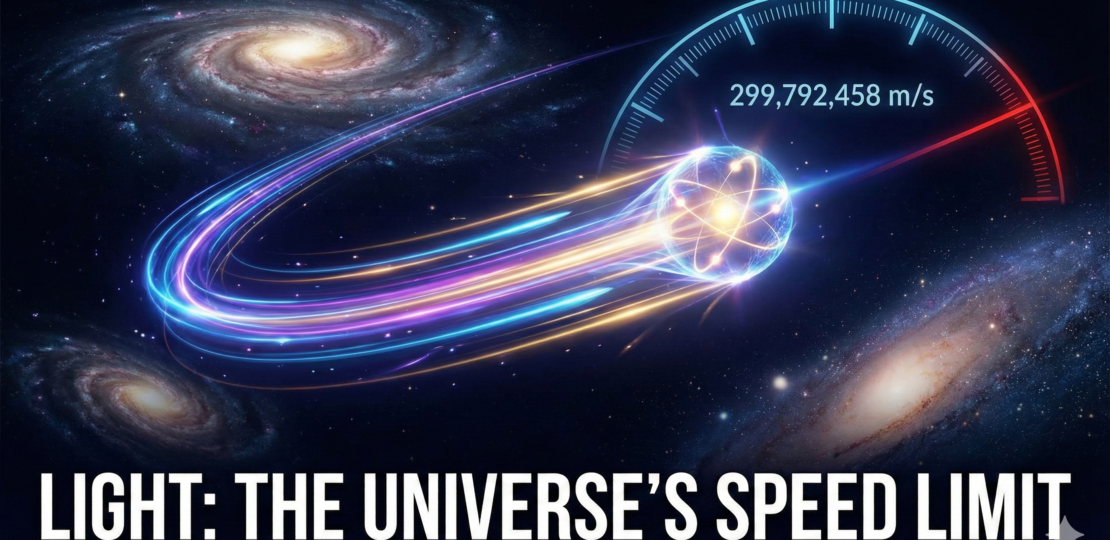
Speed feels like something we can always improve. Faster phones, faster transport, faster lives. Physics disagrees. It draws a hard, almost arrogant line in the sand: nothing with mass can move faster than light. This isn’t a limitation of our engineering skills or imagination. It’s baked into how the universe itself is structured.
As something accelerates, it doesn’t just gain speed. Time starts behaving strangely. From the outside, clocks on the fast-moving object slow down, and its mass effectively increases. Each push forward demands more energy than the last. As you approach the speed of light, the energy required grows without mercy. At the limit, it becomes infinite. The universe doesn’t forbid faster-than-light travel loudly. It just makes it impossible.
Light is the exception because it has no mass. That single fact changes everything. For light, time doesn’t pass the way it does for us. Distance along its direction of travel collapses. Emission and absorption blur into the same moment. This isn’t metaphorical—it’s what the equations insist on. Light isn’t just fast; it lives by different rules.
The deeper reason this limit matters is causality. Cause must come before effect for reality to make sense. If information could outrun light, that order would break. Different observers could disagree on what happened first. Effects could precede causes. The universe avoids this chaos by enforcing a speed limit with brutal consistency.
Light, then, is not just another particle racing through space. It sets the tempo of reality itself. The universe updates at a fixed rate, and no amount of ambition or technology gets to skip the line. In a cosmos full of strange freedoms, this is one rule it refuses to bend.
RELATED POSTS
View all