In the 1970s, a small Canadian town quietly became one of the most interesting economic experiments in history.
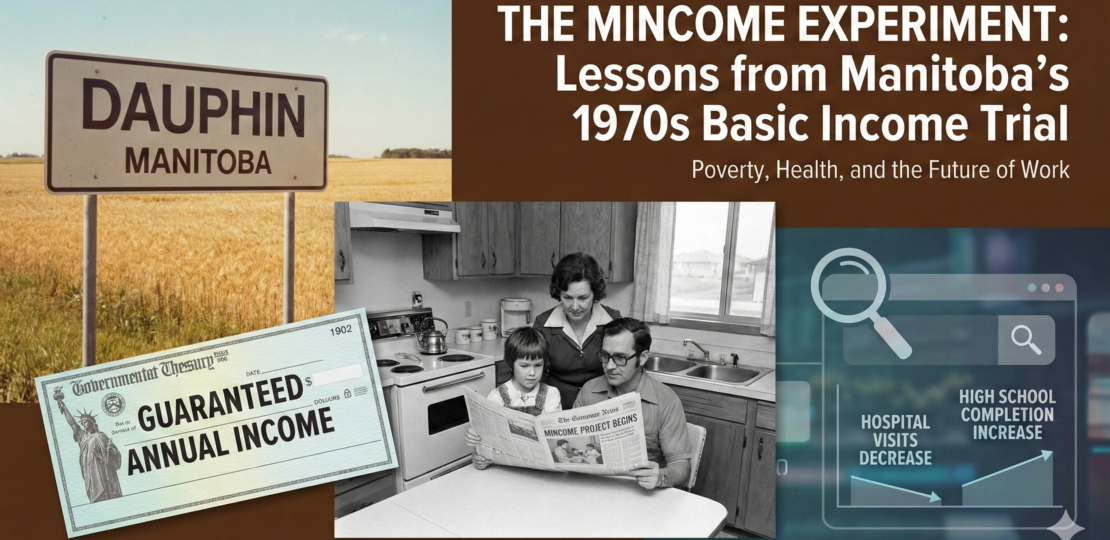
The town was Dauphin, Manitoba. The program was called Mincome. The idea was radical for its time: give people a guaranteed minimum income. No work requirement. No humiliating bureaucracy. Just a financial floor.
Economists expected chaos. The popular theory was straightforward: if you pay people not to work, they will stop working. Productivity would fall. The town would slow down. Idleness would bloom.
That’s the theory.
Then reality arrived, and it was far more subtle.
Most people did not quit their jobs. Overall work hours dropped only slightly — about 1% for men, a bit more for married women and teenagers. But the reductions were revealing. New mothers took longer maternity leave. Teenagers stayed in school longer instead of dropping out to support family income. Hospitalizations fell. Mental health outcomes improved. Stress-related visits declined.
The drop in work wasn’t a collapse. It was targeted. People used the cushion strategically.
This case is fascinating because it tests a deep economic assumption: that income and effort are tightly chained together. Classical labor models assume that if non-work income rises, labor supply falls sharply. Mincome showed that reality is more nuanced. Humans don’t simply maximize leisure. They balance dignity, security, family, education, and ambition.
There’s another layer here. Poverty itself creates cognitive load. When your mental bandwidth is consumed by financial survival, long-term planning collapses. Behavioral economists later formalized this idea as “scarcity mindset.” A guaranteed income didn’t just change wallets. It changed mental horizons.
The experiment quietly ended in 1979 due to political shifts and budget constraints. The data sat in archives for decades before researchers analyzed it properly in the 2000s. The results didn’t scream revolution. They whispered complexity.
This wasn’t a utopia. It was a case study in how modest financial security reshapes behavior in small but meaningful ways. Not mass laziness. Not explosive productivity. Just quieter lives, slightly steadier trajectories.
Economics often frames incentives as levers you pull and watch behavior jump. Dauphin suggests something softer: sometimes you raise the floor, and people adjust in human ways rather than textbook ones.
The experiment forces a question that still echoes: are people fundamentally incentive-driven machines, or are they stability-seeking organisms navigating uncertainty? The answer appears less cynical than many models assume.
Markets measure output. But experiments like Mincome measure something harder to quantify — the psychological architecture beneath economic behavior.
RELATED POSTS
View all