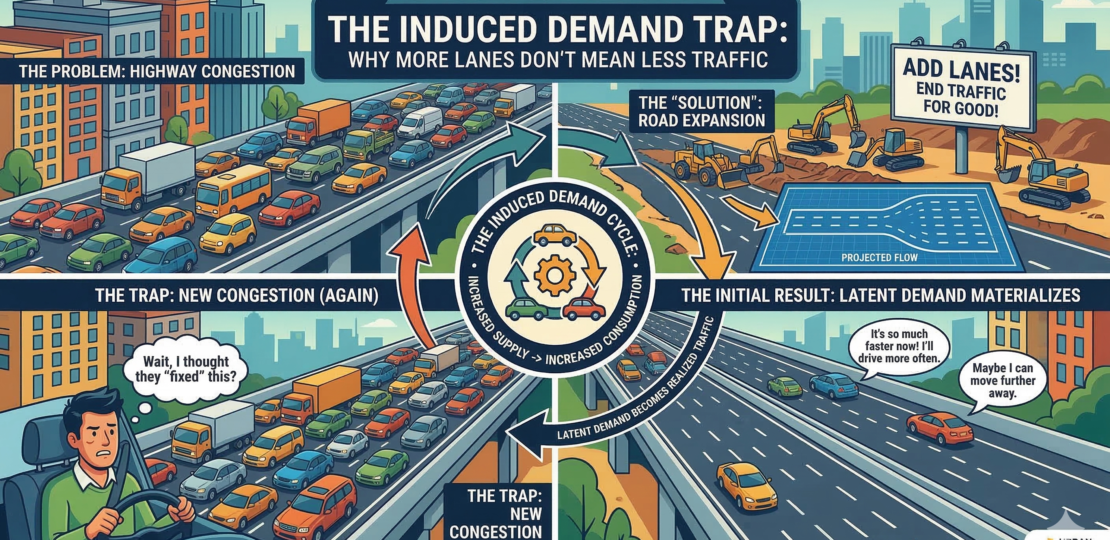
It seems obvious: if a city suffers from heavy traffic, the solution is to build more roads. Add extra lanes, expand highways, and congestion should disappear. Yet transportation economists have repeatedly observed a strange outcome. In many cities, new highway lanes fill up surprisingly quickly, and traffic returns almost to its previous level.
This phenomenon is known as Induced Demand. When road capacity increases, the “cost” of driving temporarily falls. Travel becomes faster and less frustrating, so more people decide to drive. Some commuters who previously used public transportation switch to cars. Others begin traveling during rush hour instead of avoiding it. People may even choose to live farther from work because the commute initially feels easier.
Economically, a road functions like a scarce resource. When congestion is high, the price of using that road is paid in time and stress. Expanding the road lowers that price, which increases demand for driving. The extra capacity invites additional users until the system reaches a new equilibrium—often one where traffic is heavy again.
Researchers have observed this pattern in numerous metropolitan areas. In some cases, highway expansions led to almost proportional increases in traffic volume within a few years. The road became larger, but the number of cars using it also grew.
This insight has changed how some cities approach transportation policy. Instead of only building more roads, policymakers sometimes experiment with congestion pricing—charging drivers to enter busy areas during peak times. By turning road space into a priced resource, cities attempt to manage demand directly rather than constantly expanding supply.
The broader lesson is that infrastructure does not exist in isolation from human behavior. Whenever capacity increases, people adapt their choices. A wider highway doesn’t just move existing cars more efficiently; it subtly encourages new trips, new commutes, and new patterns of living. Economics often reminds us that systems respond to incentives in ways that can quietly reshape the very problems we thought we were solving.
RELATED POSTS
View all