If you’ve followed tech headlines even loosely, you’ve probably heard about the AI boom, powerful GPUs, and the race between companies like NVIDIA and AMD. But behind all that noise is a quieter shift that might matter even more in the long run: the rise of chiplets. It sounds obscure, but it’s fundamentally changing how processors are built—and why progress hasn’t slowed down despite physical limits.
For decades, chipmakers followed a simple idea: pack everything—CPU cores, memory controllers, graphics—onto a single piece of silicon. This worked beautifully under Moore’s Law, where transistors kept shrinking. But now, making one giant, perfect chip is incredibly difficult and expensive. The larger the chip, the higher the chance that a tiny defect ruins the whole thing. It’s like trying to bake one massive, flawless cake instead of several smaller ones.
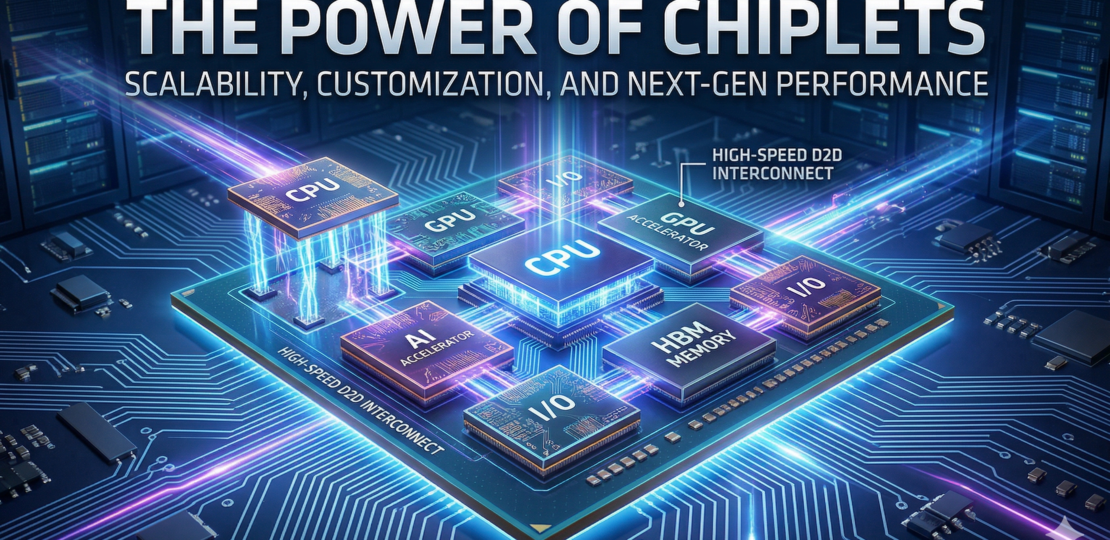
Chiplets flip that idea. Instead of one big chip, companies build multiple smaller chips—each specialized—and connect them together. Think of it like Lego blocks rather than a single sculpture. One chiplet might handle processing, another memory, another AI acceleration. These pieces are then stitched together with ultra-fast interconnects, behaving almost like a single unit.
This approach has subtle but powerful consequences. First, it dramatically reduces cost—if one small piece fails, you don’t throw away the whole system. Second, it allows faster innovation. Companies can upgrade just one part instead of redesigning everything. That’s one reason AMD has been able to compete aggressively in recent years, even overtaking older giants in some areas. And now even Intel is pivoting hard toward this model.
What makes this relevant to current affairs is how it ties into geopolitics and supply chains. Chiplets allow manufacturing to be split across regions—one part made in the U.S., another in Taiwan, another elsewhere. In a world worried about semiconductor shortages and tensions around Taiwan, this modularity could reduce risk. Instead of relying on a single factory for an entire chip, production becomes more distributed and resilient.
There’s something almost philosophical about this shift. For years, progress meant making things more unified, more integrated, more “perfect.” Now, the future seems to favor modularity—systems that are imperfect individually but powerful together. Not unlike how knowledge itself works: small pieces, connected well, creating something far greater than their parts.
RELATED POSTS
View all