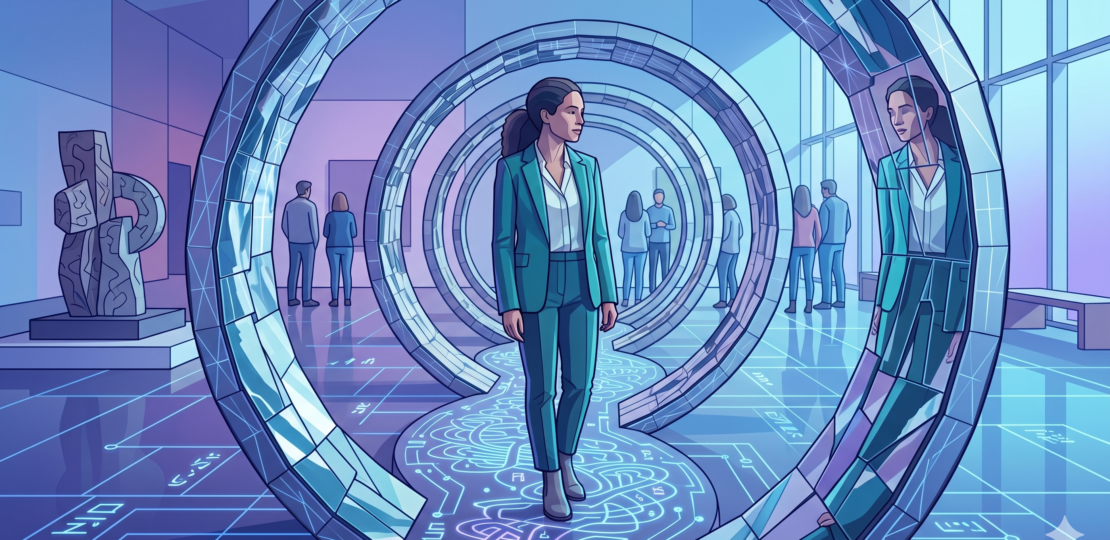
One of the most underexamined psychological shifts today isn’t just what we consume, but how what we consume begins to define us. Recommendation systems don’t simply show us content—they refine it based on past behavior, gradually building a personalized stream that feels increasingly aligned with our preferences. At first glance, this seems efficient. But over time, it creates a subtle feedback loop where our past choices begin to limit our future ones.
Psychology has long studied how identity forms through interaction with the environment, but this process is now being accelerated and narrowed. The concept of Self-Perception Theory offers a useful lens here. We don’t just act based on who we are; we also infer who we are based on what we repeatedly do. When algorithms consistently present similar types of content, they reinforce certain behaviors—and those behaviors, in turn, solidify aspects of identity. Over time, “things you clicked on” become “things you believe define you.”
This is closely tied to the mechanics of Reinforcement Learning, not just in machines but in humans. Each interaction—liking, watching, sharing—serves as a small reward signal. The system adapts, and so do we. What makes this dynamic powerful is its subtlety. There is no explicit decision to narrow one’s interests or worldview; it happens gradually, through repeated exposure to similar patterns.
The psychological consequence is a kind of identity rigidity. When people are continuously exposed to content that aligns with existing preferences, they encounter fewer challenges to those preferences. This can reduce cognitive flexibility and make alternative perspectives feel unfamiliar or even uncomfortable. In extreme cases, it contributes to polarization—but even in everyday life, it can limit curiosity and exploration.
What makes this moment significant is that identity is no longer shaped only by family, culture, or direct experience, but also by invisible systems optimizing for engagement. The implication is not that these systems are inherently harmful, but that they are not neutral. Becoming aware of this loop introduces a quiet but important question: how much of what we think of as “ourselves” is chosen, and how much is continuously suggested to us?
RELATED POSTS
View all