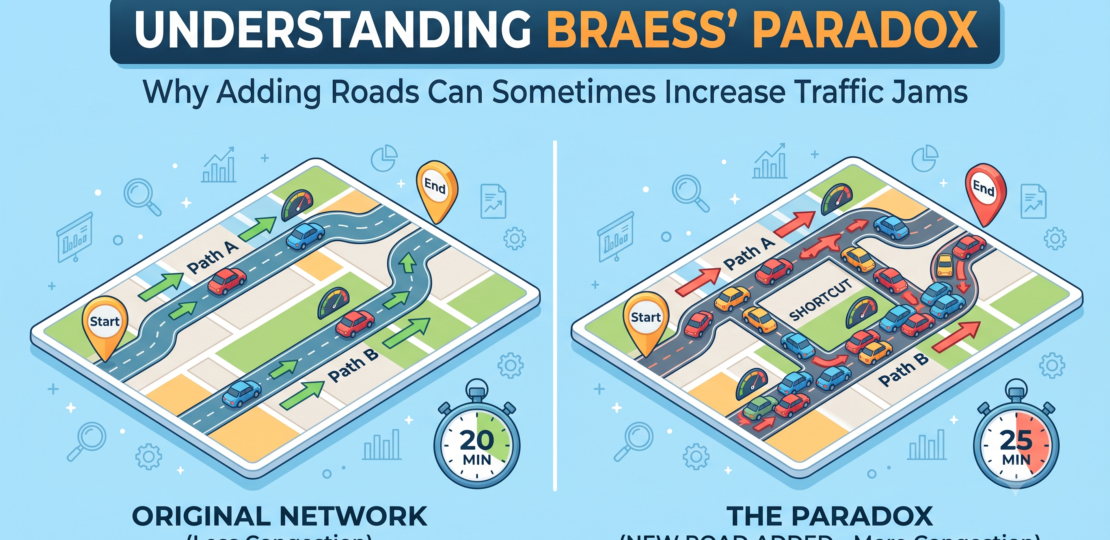
Traffic congestion is one of the most familiar problems in modern cities. The solution appears straightforward: if a road is overcrowded, build another one. More roads should allow vehicles to spread out, reducing travel times for everyone. Surprisingly, mathematics and economics suggest that adding a new road can sometimes make every driver worse off.
This counterintuitive phenomenon is known as Braess’ Paradox, first described by German mathematician Dietrich Braess in 1968. The paradox arises because drivers make decisions independently, each choosing the route they believe will minimize their own travel time. While every individual decision may be rational, the combined effect can produce a worse outcome for the entire network. In certain road systems, introducing a new route encourages drivers to change their paths in ways that increase congestion everywhere, leaving everyone with longer journeys than before.
Braess’ Paradox has moved beyond theory. Researchers have identified real-world examples where closing roads unexpectedly improved traffic flow. One of the most well-known cases occurred in Seoul, South Korea, where the removal of a major highway during the restoration of the Cheonggyecheon stream did not produce the gridlock many had predicted. Instead, traffic patterns adjusted, and congestion in the surrounding network improved. Similar effects have been observed in parts of New York City, Stuttgart, and other urban areas, demonstrating that transportation systems often behave in ways that defy intuition.
The paradox illustrates a broader economic principle: when individuals pursue what appears to be their own best outcome, the result is not always the best outcome for the group. Markets, transportation networks, and many other complex systems depend not only on the number of available choices but also on how people respond to them. Adding capacity does not automatically improve performance if it changes incentives in ways that encourage less efficient behavior.
Braess’ Paradox reminds us that complex systems cannot always be understood through common sense alone. Sometimes, solving a problem requires more than increasing resources—it requires understanding how people adapt to those resources. In economics, as in traffic, the most intuitive solution is not always the most effective one.
RELATED POSTS
View all