Imagine someone tells you one simple thing:
Don’t think about a white bear.
For the next thirty seconds, think about anything you like. Just don’t think about a white bear.
For most people, the white bear is the very first thing that comes to mind.
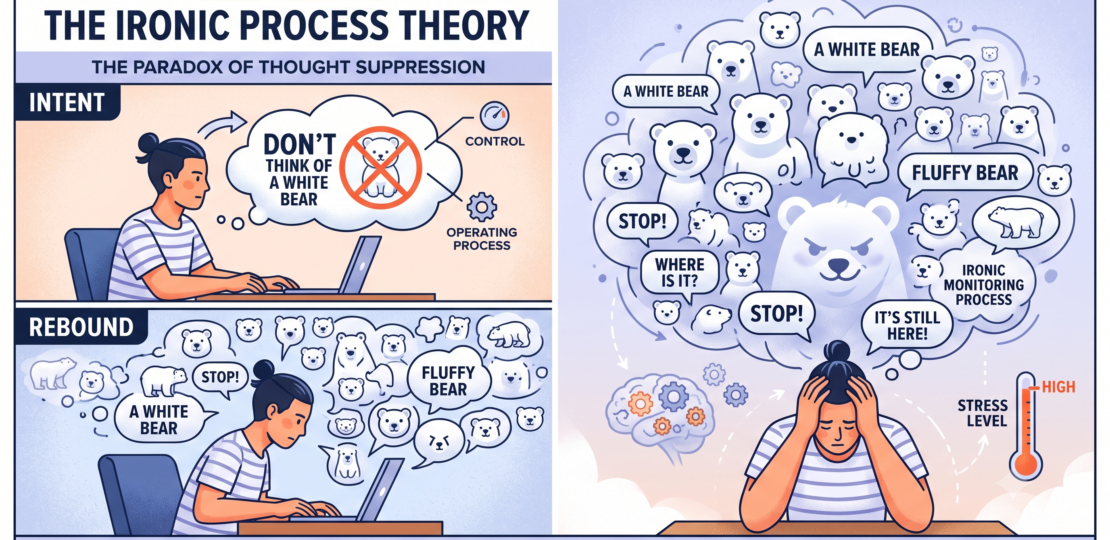
This counterintuitive phenomenon is known as the Ironic Process Theory, sometimes called the White Bear Paradox. It was first demonstrated by social psychologist Daniel Wegner in 1987. In his experiment, participants were instructed not to think about a white bear while verbalizing everything that came to mind. Whenever the forbidden thought appeared, they rang a bell. Despite their best efforts, the thought returned repeatedly. More surprisingly, when participants were later given permission to think about the white bear, they did so even more frequently than those who had never tried to suppress the thought in the first place.
Wegner proposed that the mind relies on two simultaneous processes when attempting to suppress a thought. One consciously searches for distractions to occupy attention. The other, operating automatically, continuously checks whether the unwanted thought has returned. Ironically, this monitoring process must keep the thought mentally active in order to detect it. The harder someone tries not to think about something, the more the brain quietly searches for it, making it increasingly difficult to avoid.
The White Bear Paradox has implications far beyond a simple laboratory experiment. Researchers have found similar patterns in studies of anxiety, insomnia, cravings, and intrusive thoughts. Someone trying desperately to fall asleep may become increasingly aware of the fact that they are still awake. A person attempting not to dwell on a mistake may find the memory returning again and again. In many cases, the effort to eliminate a thought unintentionally strengthens it.
The paradox does not suggest that people have no control over their thoughts. Instead, it reveals a limitation in how mental control operates. The human mind is remarkably good at directing attention, but it is far less effective at forcing itself not to think about something. Sometimes, the act of suppression gives an idea exactly the attention it needs to persist.
What began with a simple instruction about a white bear became one of the most influential findings in cognitive psychology. It challenged the assumption that conscious effort is always enough to control the mind. Occasionally, trying less can accomplish more than trying harder—not because the thought disappears, but because the brain no longer has to keep searching for it.
RELATED POSTS
View all