Series: The Return Equation
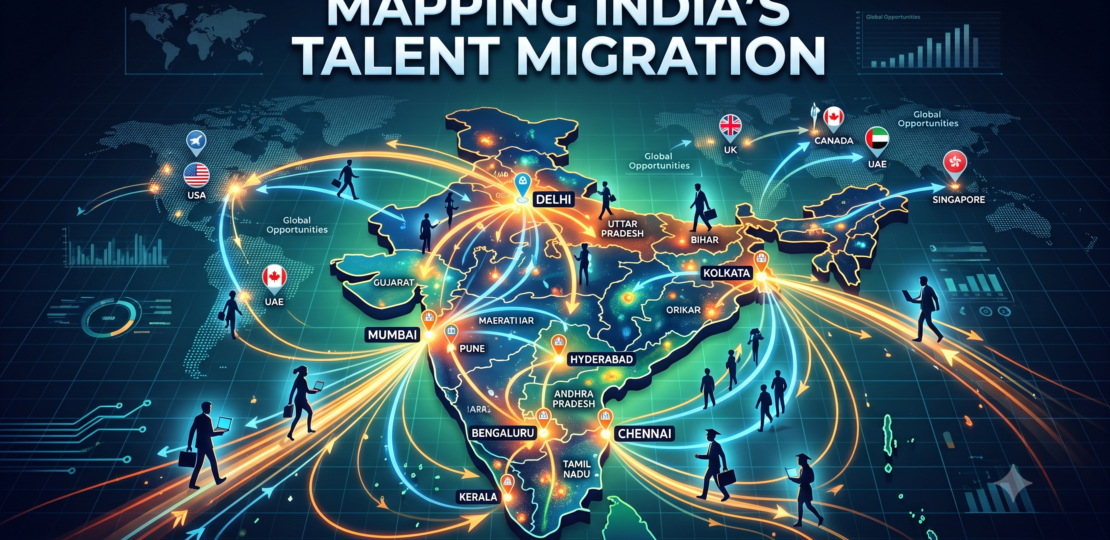
As of July 2026, India is the sixth-largest economy. Among the ten largest economies of the world, it is also the fastest growing. Yet every year, hundreds of thousands of its citizens choose to leave. Many return; many do not. Commonly referred to as ‘Brain Drain’, it is the emigration of highly skilled individuals from one country to another. Before asking why, it is important to understand the scale. This post aims to establish the scale of that migration.
Student emigration is perhaps the most visible. Over 1.3 million Indian students are abroad as of 2024, an increase from about 650,000 in 2019. While this number has come down in the last year, Indian students still compose a significant chunk of international students. Just in Canada, 40% of all international students are Indians. Indian students have become one of the largest groups within global student mobility. Foreign education is no longer a rarity; it has become an increasingly common aspiration for many.
Students, however, represent a part of a much larger migration pattern. Approximately 18 million Indians live abroad, making the Indian diaspora one of the largest in the world. In 2023 alone, 600,000 Indians migrated to OECD countries – the world’s most economically developed, high-income countries. India consistently ranks first in new migrants in those countries from 2020. It is no longer a case of isolated decisions; it is a persistent and measurable trend.
The migration is also concentrated in particular professions. Engineering and Computer Science account for a substantial share of skilled migration. Silicon Valley offers a striking example: 23% of all of its foreign workforce come from India, the highest for any country. Healthcare tells a similar story. India is consistently the top source of migrant physicians to OECD countries. While migration occurs across virtually every profession, STEM fields are disproportionately represented among highly skilled migrants.
However, this is only one side to the coin. India receives the largest amount of remittances of any country. It receives close to $140 billion per year in remittances. Money sent to families, investment capital, and professional expertise continue to flow back to India. Researchers are beginning to distinguish brain drain from brain circulation, where migrants contribute to India even when not physically present.
Nor has outward migration hindered rapid development of India. While facing historically high levels of emigration, India’s domestic production and innovation, anything from tech to agriculture, has undergone remarkable growth. In just the aerospace industry, India went from exactly 1 registered space startup in 2014 – one that was completely under the umbrella of ISRO – to more than 500 startups in 2026 with many of them receiving private funding in millions. India has become an increasingly attractive destination for foreign investment. Google has established a major presence in Hyderabad. Apple has significantly expanded its manufacturing presence in Tamil Nadu. Yet people are leaving.
Statistics tell the story, but not the decision. India continues to grow, yet people continue to leave. Why? Every departure carries thousands of calculations involving career ambitions, financial security, family, identity, and personal aspirations. One aspect, however, is always mentioned first: money. But how large are those financial incentives—and do they come with a catch?
RELATED POSTS
View all