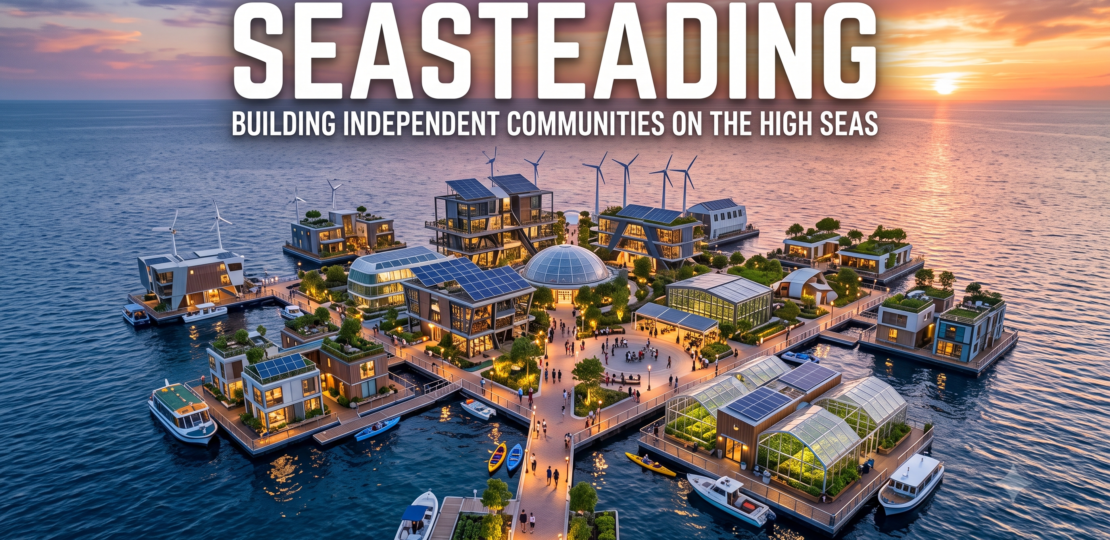
For thousands of years, cities have been anchored to land. Civilization grew around rivers, coastlines, and fertile plains because the ocean was viewed as a barrier rather than a destination. Yet with rising sea levels, increasing urban populations, and advances in marine engineering, that assumption is beginning to change. Around the world, engineers are exploring a question that once belonged exclusively to science fiction: what if entire communities could float?
The idea is known as Seasteading—creating permanent, self-sustaining settlements on floating platforms. While images of futuristic ocean metropolises often dominate the conversation, the engineering begins much smaller. Companies and research organizations are developing modular floating platforms that can be connected like building blocks, allowing cities to expand over time instead of being constructed all at once. Inspired by offshore oil rigs, these platforms are designed to withstand waves, corrosion, and even powerful storms while supporting homes, businesses, and public infrastructure.
Making such communities practical requires solving a surprising number of engineering challenges. Fresh water must be produced through desalination, electricity generated from a combination of solar panels, offshore wind turbines, and wave energy converters, while waste must be recycled within a largely closed system. Autonomous vessels could transport supplies between floating communities and the mainland, and advances in smart materials may one day allow structures to monitor their own structural health, detecting fatigue long before it becomes dangerous. The goal is not simply to survive at sea, but to create an environment capable of supporting everyday life for thousands of people.
Although true floating cities remain decades away, many of their building blocks already exist. Floating neighborhoods have been proposed in places such as South Korea, offshore wind farms are proving that large-scale infrastructure can thrive in harsh marine environments, and improvements in marine robotics continue to reduce the cost of maintaining structures far from shore. Humanity may never abandon its continents, but the next frontier of urban development may not lie beyond the horizon of space—it may be floating quietly upon the oceans that have surrounded us all along.
RELATED POSTS
View all