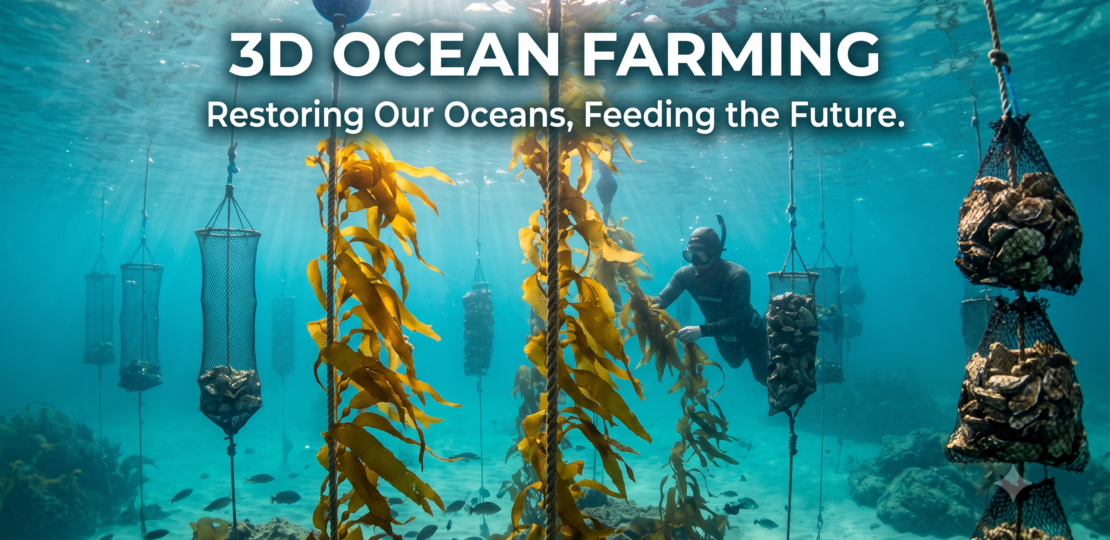
For centuries, harvesting food from the ocean has largely meant catching what nature provides. Yet as fish populations decline and global demand for protein continues to rise, engineers are beginning to rethink this relationship. Instead of hunting marine life, what if the ocean itself could become a carefully engineered farm—one that restores ecosystems while producing food?
The concept is known as 3D ocean farming. Unlike traditional aquaculture, which often relies on large fish pens, 3D farms grow multiple species throughout the water column. Seaweed is suspended from ropes near the surface, mussels and oysters attach themselves to hanging lines, and shellfish grow below. These farms require no freshwater, fertilizer, or feed. In fact, many of the organisms naturally filter pollutants from the surrounding water while absorbing carbon dioxide and excess nutrients that contribute to harmful algal blooms.
Making these farms viable on a large scale is an engineering challenge. Offshore structures must survive hurricanes, corrosion, and powerful ocean currents while remaining inexpensive to deploy and maintain. Autonomous underwater drones are being developed to inspect ropes and anchors, while sensor networks continuously monitor water quality, currents, and biological growth. Researchers are even exploring AI systems capable of predicting storms and adjusting farm operations before severe weather arrives.
Although the vision of vast offshore food farms is still developing, its appeal extends beyond producing seafood. It represents a shift in engineering philosophy—from extracting resources as quickly as possible to designing systems that work alongside natural ecosystems. If successful, the future of ocean engineering may not be defined by building larger fishing fleets, but by creating farms that leave the ocean healthier than they found it.
RELATED POSTS
View all