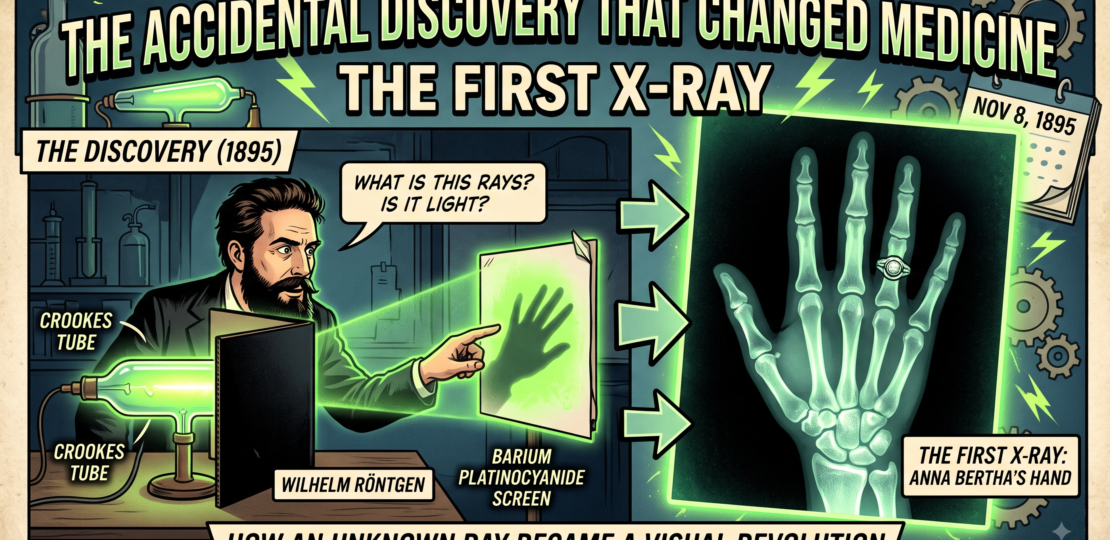
In 1895, German physicist Wilhelm Röntgen was experimenting with a device called a Crookes tube, which produced beams of electrons inside a glass tube. He was studying cathode rays and had covered the tube with black cardboard so that no visible light could escape.
Then something strange happened.
Across the room, Röntgen noticed a fluorescent screen glowing.
It shouldn’t have been glowing. The tube was covered, and the screen was far enough away that the cathode rays he was studying could not have reached it. Something invisible was traveling through the laboratory.
Röntgen began investigating. He placed different objects between the tube and the screen and discovered that the mysterious radiation could pass through materials that blocked ordinary light. When he placed his hand in its path, something even stranger appeared: an image showing the bones inside his hand.
He had discovered a previously unknown form of electromagnetic radiation.
Röntgen called it X-rays, using “X” to signify that their nature was unknown. Within weeks, scientists were experimenting with the new technology. Doctors quickly realized its extraordinary potential. For the first time, they could look inside a living human body without cutting it open.
One of the earliest famous medical X-rays was an image Röntgen made of his wife’s hand. Her bones, joints, and wedding ring appeared clearly against the surrounding tissue. The photograph was so strange that his wife reportedly thought she was looking at her own death.
The discovery transformed medicine. Broken bones could be located precisely. Bullets could be found inside injured soldiers. Diseases affecting the lungs and other organs could be investigated without surgery. Eventually, X-ray imaging became a routine part of modern medicine and developed into technologies such as CT scanning.
What makes Röntgen’s discovery remarkable is that he wasn’t searching for X-rays at all. He was studying something else entirely when an unexplained glow appeared where it shouldn’t have.
The experiment had produced an anomaly. Röntgen could have covered the screen, adjusted his equipment, and continued his original work.
Instead, he stopped and asked the most valuable question a scientist can ask when reality behaves strangely:
Why?
RELATED POSTS
View all