

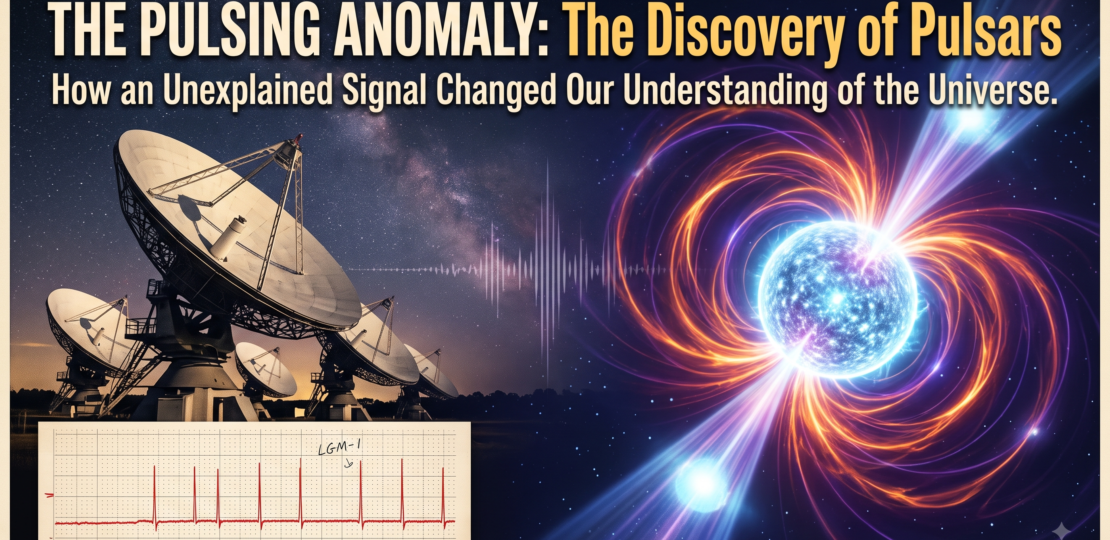
In 1967, a young graduate student named Jocelyn Bell Burnell was working at the University of Cambridge, helping build and operate a massive radio telescope designed to study quasars—extremely distant, energetic objects at the edge of the universe.
The telescope produced enormous amounts of data, covering miles of chart recordings. Bell Burnell spent hours examining the strange patterns buried in them, looking for anything that might indicate a quasar. Most of the marks were meaningless noise. But one day, she noticed something unusual: a tiny, repeating signal appearing at remarkably precise intervals.
It was so regular that it seemed almost artificial.
The signal appeared every 1.337 seconds. Bell Burnell initially jokingly referred to its mysterious source as “LGM”—short for “Little Green Men”—because its extraordinary regularity raised the faint possibility that it might be an extraterrestrial transmission. The team eventually ruled out aliens and discovered something far more extraordinary.
The signal was coming from a previously unknown type of astronomical object: a pulsar.
A pulsar is a rapidly rotating neutron star, the incredibly dense remnant left behind after a massive star explodes. As it spins, beams of radiation sweep through space like the beam of a lighthouse. When one of those beams points toward Earth, radio telescopes detect a pulse. Some pulsars rotate hundreds of times every second with extraordinary precision.
The discovery opened an entirely new way of studying the universe. Pulsars became natural cosmic clocks, allowing astronomers to investigate neutron stars, test Einstein’s theory of relativity, detect planets orbiting distant stars, and eventually develop techniques for detecting gravitational waves.
The strange part is that Bell Burnell wasn’t looking for pulsars. She was looking for quasars. The crucial signal appeared in what initially looked like an insignificant irregularity in thousands of feet of chart paper.
The discovery is a reminder that scientific progress sometimes depends less on finding what was expected than on noticing what wasn’t. The universe had been sending out these pulses for millions of years. Humans simply needed someone curious enough to notice that one tiny pattern in the noise was different.
And in astronomy, sometimes the anomaly is the discovery.
RELATED POSTS
View all



Status Quo Bias: Why We Resist Change Even When It’s for the Better
March 6, 2025 | by Venkat Balaji