One of the strangest facts hidden inside the human genome is that part of it did not originate in humans—or even in our distant animal ancestors. Over millions of years, viruses have repeatedly inserted their genetic material into the genomes of the organisms they infected. Some of these sequences eventually became permanent residents.
Most viral DNA that enters a genome is useless. It accumulates mutations, becomes inactive, and survives only as a molecular relic. But occasionally, evolution finds a use for one of these ancient intruders.
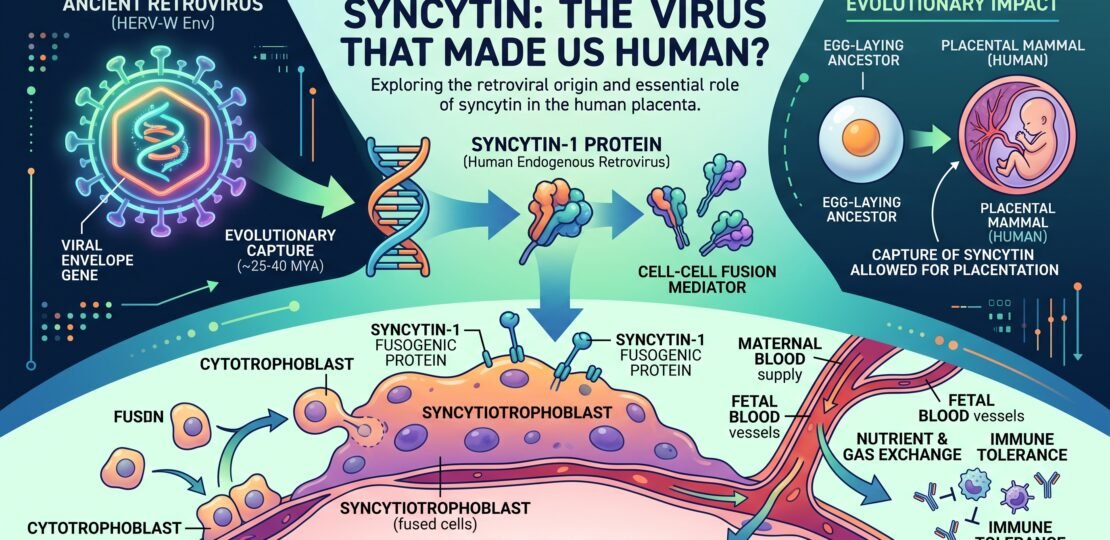
One remarkable example involves syncytin, a protein that helps cells fuse together. This ability is essential for the formation of the placenta. The surprising part is where the gene encoding this protein came from: an ancient retrovirus.
Retroviruses have an unusual reproductive strategy. Instead of simply replicating inside a cell, they convert their RNA into DNA and insert that DNA into the host genome. If this happens in a cell that eventually contributes to eggs or sperm, the viral sequence can be passed to future generations.
Over evolutionary time, some of these viral genes were modified and incorporated into the biology of their hosts. What was once part of a virus could become part of an essential developmental process.
This is a remarkable example of evolution by genetic borrowing. New biological functions do not always emerge from completely new genes. Sometimes evolution takes existing genetic machinery and gives it a new purpose.
The phenomenon is not unique to humans. Viral sequences have accumulated throughout the genomes of mammals and other organisms, leaving behind a vast molecular record of ancient infections. Some remain inactive. Others have been repurposed in ways scientists are still discovering.
The genome, therefore, is not merely a family inheritance passed down through generations. It is also an archive of ancient encounters—with mutations, environmental pressures, genetic accidents, and even viruses.
Some of the most important biological machinery in the human body may have begun as something that once tried to destroy it.
Evolution did not simply defeat the invader.
It kept part of it.
RELATED POSTS
View all