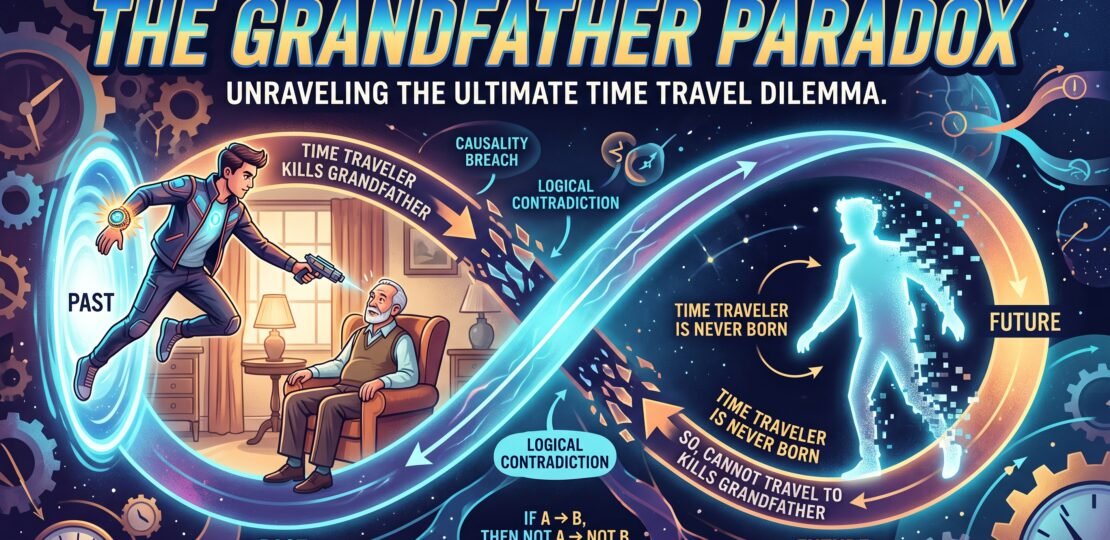
Imagine a time traveler who goes back to the past and meets his grandfather before his grandfather has ever met his grandmother. For some reason, the traveler prevents the two from ever meeting. His grandfather never has a child, his parent is never born, and therefore the traveler is never born either. But if the traveler was never born, how could he have traveled back in time to prevent his grandfather from having children in the first place?
This is the Grandfather Paradox, one of the simplest and most famous problems associated with time travel. It creates a contradiction in the ordinary idea of cause and effect. The traveler causes an event that prevents the existence of the very person who caused that event. The past seems capable of erasing the future that produced it.
One possible solution is that the past simply cannot be changed. The universe might somehow prevent contradictions from occurring: perhaps the gun jams, the traveler misses his grandfather, or some other event always intervenes. This idea is related to the Novikov self-consistency principle, which proposes that events occurring in a time-traveling universe must remain logically consistent with the history that already exists. Under this view, the traveler could visit the past, but he could never actually create a contradiction.
Another possibility is that changing the past creates an entirely different future. The traveler could prevent his grandfather from having children, but instead of erasing himself, he would create a new timeline in which a different version of history unfolds. His original timeline would still exist, while the altered timeline would simply contain no version of him. This avoids the contradiction, although it introduces an even stranger question: how many versions of history might exist, and what does it mean to say that one of them is “the real” one?
The paradox ultimately reveals something deeper than the question of whether time machines are possible. Our understanding of the world depends heavily on the assumption that causes come before their effects. The grandfather paradox breaks that assumption by allowing an effect to travel backward and interfere with its own cause. If the past could be changed freely, the distinction between cause and consequence would become surprisingly difficult to maintain. Perhaps the strangest thing about time travel is not traveling through time itself, but discovering that causality may be what keeps reality logically coherent.
RELATED POSTS
View all