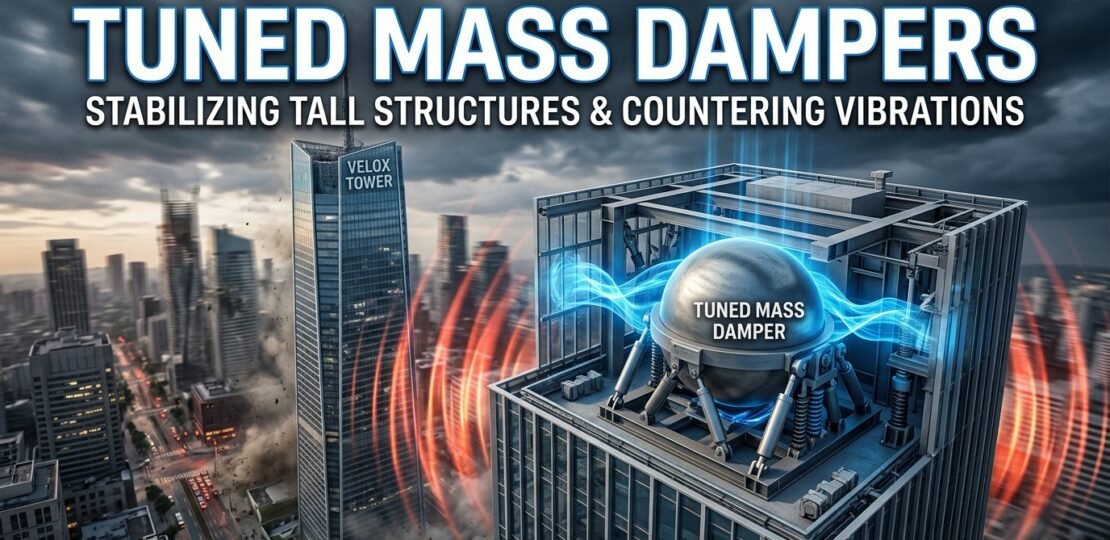
Tall buildings are designed to withstand enormous forces, but one of their greatest enemies is something that seems almost harmless: wind. A skyscraper does not need to be hit by a hurricane to move. Even an ordinary strong wind can cause a building hundreds of meters tall to sway several inches. The movement is usually safe, but for people inside, it can become uncomfortable. Engineers therefore face an unusual problem: instead of making the entire building completely rigid, they sometimes deliberately add something that moves inside it.
This is the principle behind a tuned mass damper, a large mass installed inside certain tall structures to reduce their motion. The idea is remarkably simple. If the building begins to sway in one direction, the mass is designed to move in the opposite direction. Its motion absorbs part of the building’s energy, reducing the overall oscillation. The system is essentially a giant mechanical oscillator, consisting of a mass, a restoring force, and damping.
The mathematics is closely related to the same equations used to describe springs and pendulums. Every structure has natural frequencies at which it prefers to vibrate. If external forces repeatedly push the structure near one of those frequencies, the motion can become much larger through resonance. Engineers can therefore design the damper so that its own natural frequency is carefully matched to the problematic frequency of the building. Instead of fighting vibration with brute force, the system exploits the physics of vibration itself.
One of the most famous examples is Taipei 101, which contains a massive steel sphere suspended between floors near the top of the building. The sphere weighs hundreds of tons and can move relative to the structure. During strong winds or earthquakes, its motion helps counteract the movement of the tower. What looks like an enormous decorative object is actually a carefully engineered mechanical system.
The fascinating part is that the solution does not make the building stronger in the conventional sense. Engineers did not simply add more concrete and steel until the structure stopped moving. They allowed the movement to happen and then designed another moving system to oppose it. Sometimes the best way to control a complicated engineering problem is not to eliminate the physics, but to understand it well enough to make the physics work in your favor.
RELATED POSTS
View all