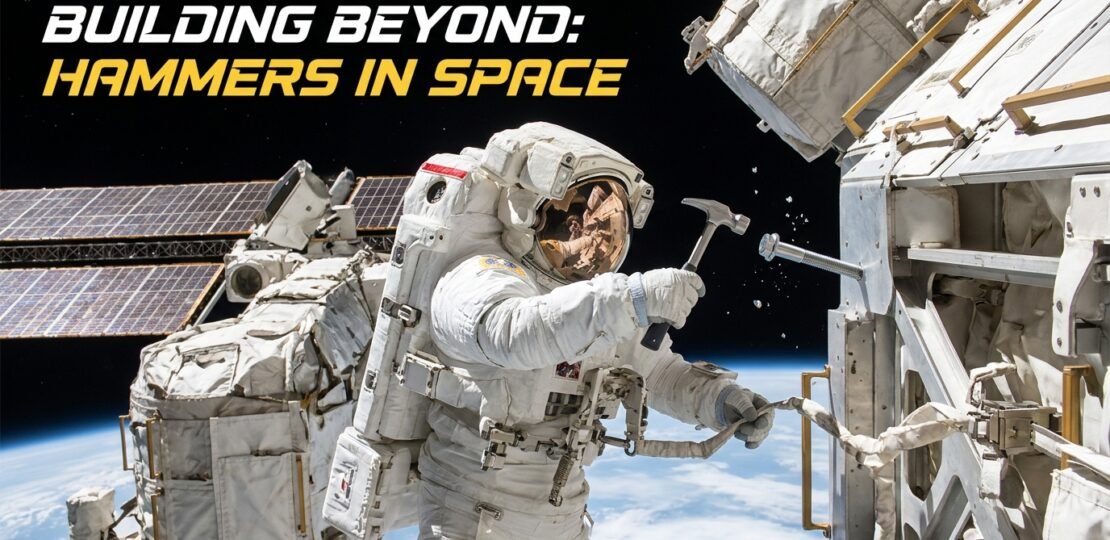
In the 1960s, NASA faced an engineering problem that few people would have anticipated before the Space Race: how could astronauts use ordinary tools in the weightlessness of space? On Earth, a hammer works because gravity, friction, and the resistance of the surrounding environment make the task relatively straightforward. In orbit, however, striking an object produces an equal and opposite reaction. Without a stable surface to provide resistance, an astronaut using a hammer could send themselves drifting in the opposite direction. A tool that had worked perfectly for centuries suddenly presented an entirely different challenge.
The problem illustrates a fundamental truth about engineering: a solution cannot be separated from the environment in which it must operate. A tool is not effective simply because it performs its intended function under familiar conditions. It must also account for the forces, constraints, and limitations of its surroundings. The engineering principles that make a hammer useful on Earth do not disappear in space, but the conditions under which those principles operate change dramatically. What was once a simple task becomes a problem requiring a different approach.
Engineers working on space missions must therefore consider far more than whether an object can perform its primary function. Tools must be compact enough to fit aboard spacecraft, light enough to minimize launch costs, durable enough to survive extreme conditions, and safe enough to use in a confined environment. A minor design flaw can become a serious operational hazard when there is no convenient way to replace a component or repair equipment. The challenge is not merely to create a tool that works, but to create one that works reliably under the precise conditions for which it was designed.
This way of thinking extends beyond space exploration. A bridge designed for ordinary traffic may fail when subjected to loads it was never intended to carry. A computer program that performs flawlessly with a small dataset may become unusable when millions of records are introduced. A manufacturing process that works efficiently in a laboratory may prove impractical when scaled to an industrial facility. In each case, the mistake is not necessarily a failure of the underlying principle. It is a failure to account for the environment in which the principle must be applied.
There is an important distinction between solving a problem and solving it under the conditions that actually matter. Engineers sometimes become so focused on making an individual component perform better that they overlook the larger system in which it must function. A stronger material, a more powerful motor, or a more sophisticated mechanism may appear to be an improvement, but the additional weight, cost, energy consumption, or complexity can create new difficulties elsewhere. Good engineering requires evaluating the entire system rather than optimizing a single part in isolation.
Space exploration makes this distinction particularly clear because its constraints are unforgiving. Every kilogram launched into orbit has a cost, every component must justify its presence, and every operation must account for conditions that cannot easily be reproduced on Earth. These limitations force engineers to question assumptions that would otherwise go unchallenged. The result is a broader lesson for any field: before adapting a familiar solution to a new problem, one must first understand what has changed about the problem itself.
The next time a familiar tool or method fails in an unfamiliar situation, the instinct may be to improve the tool. Sometimes that is necessary. But the more important question is whether the original solution was designed for the conditions now confronting it. A hammer does not become a bad tool simply because it behaves differently in orbit. It reveals the limits of a solution when its environment changes. Good engineering begins not with the question of how to make something work, but with an understanding of the conditions under which it must work.
RELATED POSTS
View all