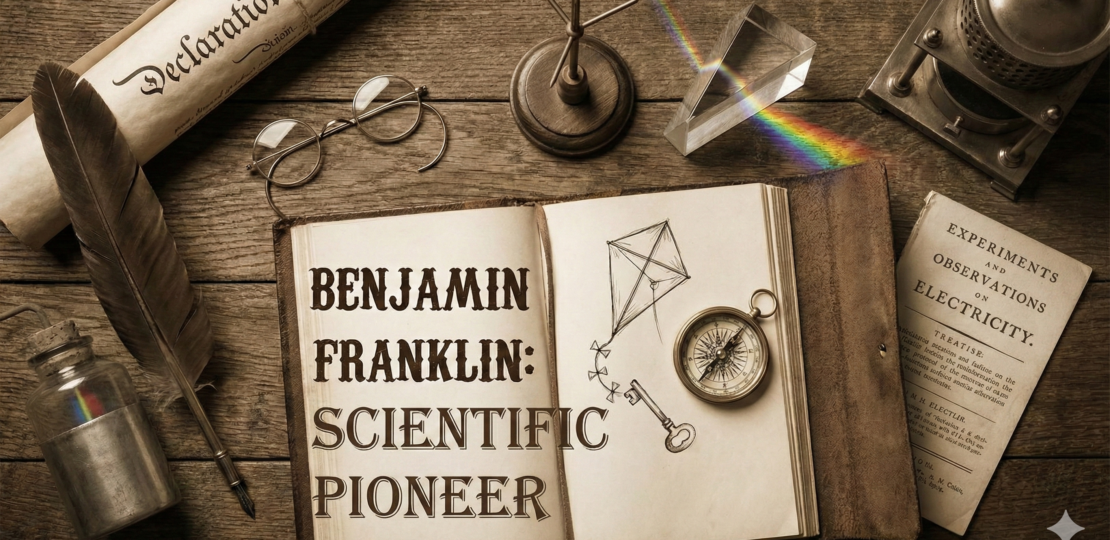
When most people think of Benjamin Franklin, they picture a founding father, a diplomat, or the face on the hundred-dollar bill. Few immediately think of him as a groundbreaking physicist—but Franklin’s contributions to science were just as electrifying as his role in shaping a nation.
Franklin’s curiosity about the natural world led him to study electricity at a time when it was still mysterious and magical. His most famous experiment—flying a kite in a thunderstorm with a metal key attached—proved that lightning was a form of electricity. Beyond the drama, this discovery laid the groundwork for practical inventions like the lightning rod, which protects buildings and saves lives to this day.
Franklin also pioneered ideas about positive and negative charges and the conservation of charge, establishing principles that guided later scientists, including Michael Faraday (ring a be. He combined hands-on experimentation with a playful, inventive mind, showing that science could be accessible, exciting, and useful.
While Franklin helped draft constitutions and negotiate treaties, he also helped humanity understand the invisible forces of nature. His scientific legacy reminds us that even the most famous politicians can be brilliant experimenters, blending curiosity, rigor, and courage in ways that literally change the world.
RELATED POSTS
View all