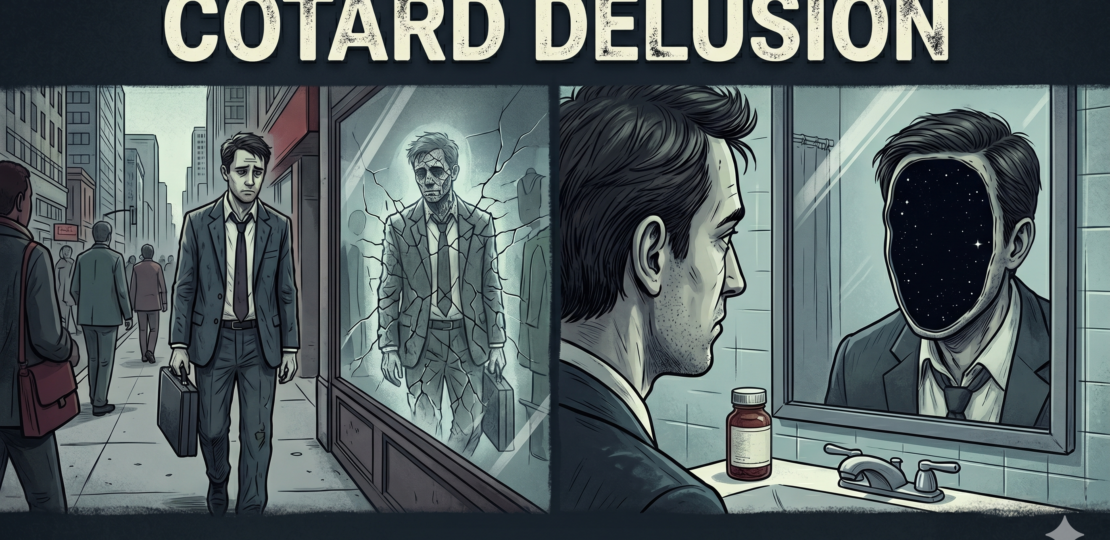
There are rare psychological conditions where the mind does not simply misinterpret reality, but quietly replaces it with an entirely different one.
One of the rarest among them is something known as Cotard delusion. In documented clinical cases, individuals become convinced that they are dead, do not exist, or have lost their internal organs entirely. Some report that they have no blood running through their body. Others believe they are decomposing while still walking around.
It sounds symbolic at first, almost like a metaphor the brain might use under extreme distress. But in rare cases, it is experienced literally.
Cotard delusion is not a personality shift or a temporary mood distortion. It is a breakdown in the systems that normally anchor self-perception to reality. The brain constructs a model of the “self” by integrating memory, sensory signals, and emotional feedback. When parts of this system malfunction, the sense of existence itself can become unstable. The result is not confusion about the outside world, but a collapse of certainty about the internal one.
What makes this condition especially striking is how internally consistent it can be. People affected are not confused in a random way. Instead, they often develop structured explanations for why they do not exist. Some interpret their experiences through medical, spiritual, or physical frameworks. The mind does not tolerate a gap in self-awareness—it fills it, even if the conclusion is that the self is gone.
Cases of Cotard delusion are extremely rare, appearing only occasionally in psychiatric literature, often in connection with severe depression, neurological illness, or brain injury. Because of its rarity, it is not fully understood, and no single mechanism explains it completely. It appears when multiple layers of cognition—emotion, perception, and identity—stop aligning in the usual way.
What makes it psychologically important is not just its extremity, but what it reveals about ordinary experience. Most of the time, the feeling of being alive is not something we actively verify. It is a background assumption, continuously maintained without effort. Cotard delusion exposes that assumption by showing what happens when it fails.
The condition is rare enough that most clinicians will never encounter a full case in their careers. Yet its existence is enough to challenge something fundamental: that awareness of being alive is stable, direct, and unquestionable. In reality, it is a constructed state, held together by systems that usually go unnoticed until they stop agreeing with each other.
In that sense, Cotard delusion is not only about those who experience it. It is also a reminder of how much of identity depends on processes that normally remain invisible.
RELATED POSTS
View all