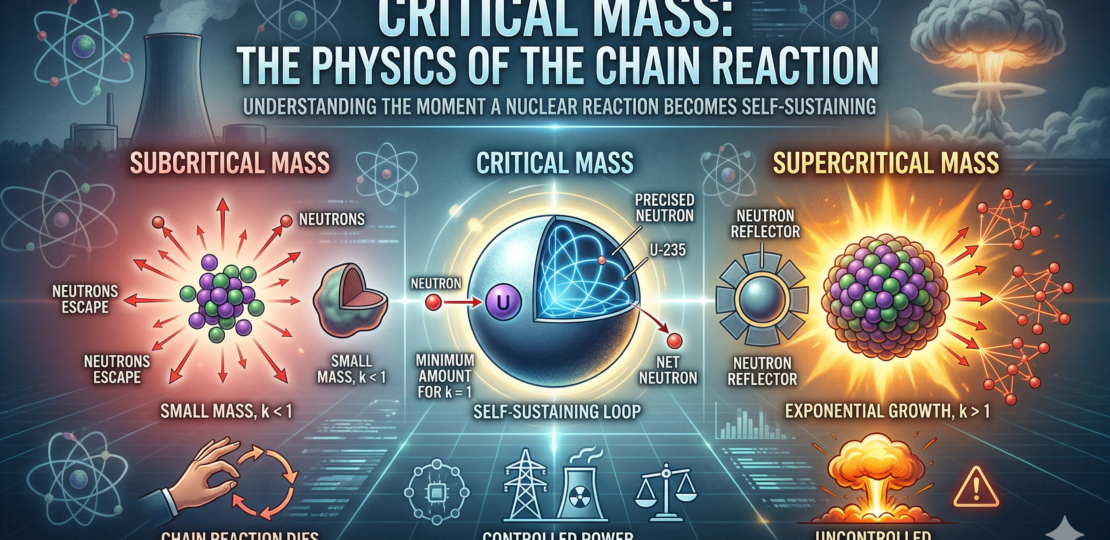
There’s a quiet threshold hidden inside nuclear physics — a line between nothing happening and everything happening at once. It’s called critical mass, and it determines whether a nuclear reaction fades out or sustains itself. When a heavy nucleus splits, it releases energy along with a few free neutrons. Those neutrons may escape, get absorbed harmlessly, or trigger more fissions. Everything depends on what happens next.
If, on average, each fission leads to less than one more, the reaction dies out. If it leads to exactly one, the system is critical — stable, balanced, self-sustaining. But if it leads to more than one, the reaction grows exponentially. That delicate middle point is the knife edge where control exists.
What makes this fascinating is that critical mass isn’t just about quantity. Shape, density, and arrangement matter just as much. A small chunk of material loses too many neutrons from its surface. But as it gets larger or more compact, more neutrons stay inside, increasing the chance of further reactions. Even slight changes — like compressing the material or surrounding it with neutron reflectors — can push it across the threshold.
In nuclear reactors, this balance is carefully maintained. The system is kept at or near criticality to produce steady energy. In contrast, nuclear weapons force the system rapidly into a supercritical state, where the reaction accelerates uncontrollably. Same physics — completely different intent.
What this reveals is something deeper: some systems don’t change gradually. They sit quietly until a threshold is crossed, and then their behavior transforms entirely. Below critical, nothing much happens. Above it, everything changes.
RELATED POSTS
View all


Status Quo Bias: Why We Resist Change Even When It’s for the Better
March 6, 2025 | by Venkat Balaji