Imagine engineers invent a car engine that uses half as much fuel to travel the same distance. The immediate assumption is simple: fuel consumption should fall. After all, if every journey requires less gasoline, society should use less of it. Surprisingly, history has shown that the opposite can happen.
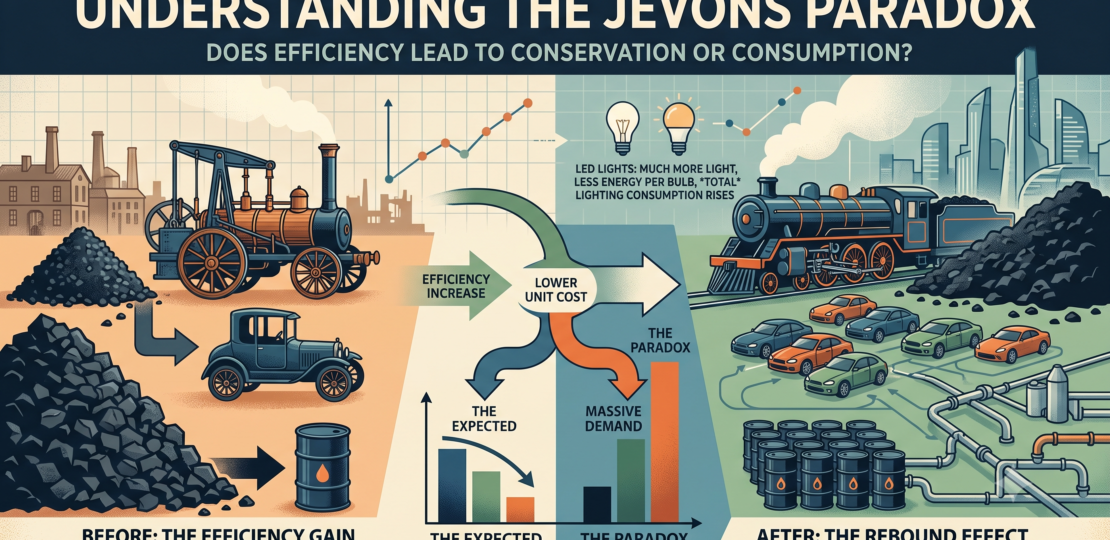
This phenomenon is known as the Jevons Paradox, first described by the English economist William Stanley Jevons in The Coal Question (1865). During the Industrial Revolution, improvements in steam engine efficiency dramatically reduced the amount of coal needed to produce power. Rather than decreasing Britain’s coal consumption, these innovations made coal-powered machinery cheaper to operate. Industries expanded, new applications emerged, and demand for coal grew so rapidly that total coal consumption increased. Greater efficiency had made the resource more valuable to use, not less.
The paradox arises because efficiency changes incentives. When something becomes cheaper to use, people often use more of it. Fuel-efficient cars encourage longer trips. More efficient lighting lowers electricity costs, leading households and businesses to install more lights. Advances in computing have made processing power dramatically cheaper over the past few decades, yet global demand for data centers and electricity continues to rise as digital services become more widespread. In each case, the savings from efficiency are partially—or sometimes entirely—offset by increased consumption, a response economists refer to as the rebound effect.
The Jevons Paradox does not imply that efficiency is undesirable. On the contrary, efficiency remains one of the most important drivers of technological progress and economic growth. It does, however, remind us that human behavior adapts to changing incentives. Markets respond not only to how much of a resource is required, but also to how affordable it becomes to use. As a result, making a resource more efficient does not automatically guarantee that society will consume less of it.
The paradox remains highly relevant in debates surrounding energy, sustainability, and climate policy. Improving efficiency is often an essential part of reducing environmental impact, but it may not be sufficient on its own. By demonstrating that technological progress can sometimes increase, rather than decrease, total resource consumption, Jevons’ insight continues to shape the way economists think about innovation and its unintended consequences.
RELATED POSTS
View all