Move your eyes left and right quickly.
The image on your retina is shifting wildly every time you do that. Physically, the world should smear and jump. But it doesn’t. Your experience is stable, continuous, almost eerily smooth. That stability is not a property of the world—it’s a trick your nervous system performs using something called an efference copy.
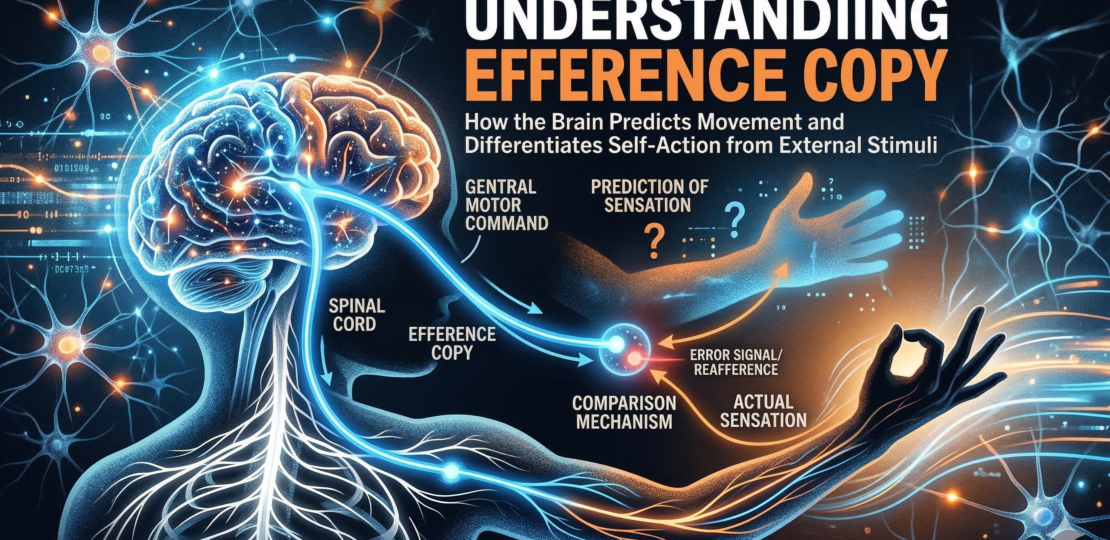
When your brain sends a motor command—say, to move your eyes—it also sends a copy of that command to sensory areas. This “heads-up message” tells the brain, we’re about to move; expect incoming changes. So when the visual input shifts, the brain doesn’t interpret it as the world moving. It attributes the change to your own action and cancels out the disturbance.
This is why you can’t tickle yourself effectively. When you try, your brain predicts the sensation using that same internal copy. There’s no surprise, no mismatch, no strong response. But when someone else tickles you, the sensory input isn’t predicted precisely—so it feels intense and uncontrollable. The nervous system cares deeply about prediction errors.
Efference copy shows up all over the place. It helps stabilize vision during rapid eye movements (called saccades). It helps distinguish self-generated sounds (like your own voice) from external ones. It even plays a role in the sense of agency—the feeling that I caused this action.
Here’s the unsettling layer. Your brain is constantly subtracting your own influence from the sensory world. What you experience is not raw input—it’s input with your actions mathematically removed. You live inside a corrected version of reality.
That raises a strange possibility. The boundary between “self” and “world” is not directly perceived. It’s computed. Your nervous system is quietly solving a puzzle every moment: which changes belong to me, and which belong to everything else? And the answer feels so natural that you never notice the calculation happening.
RELATED POSTS
View all