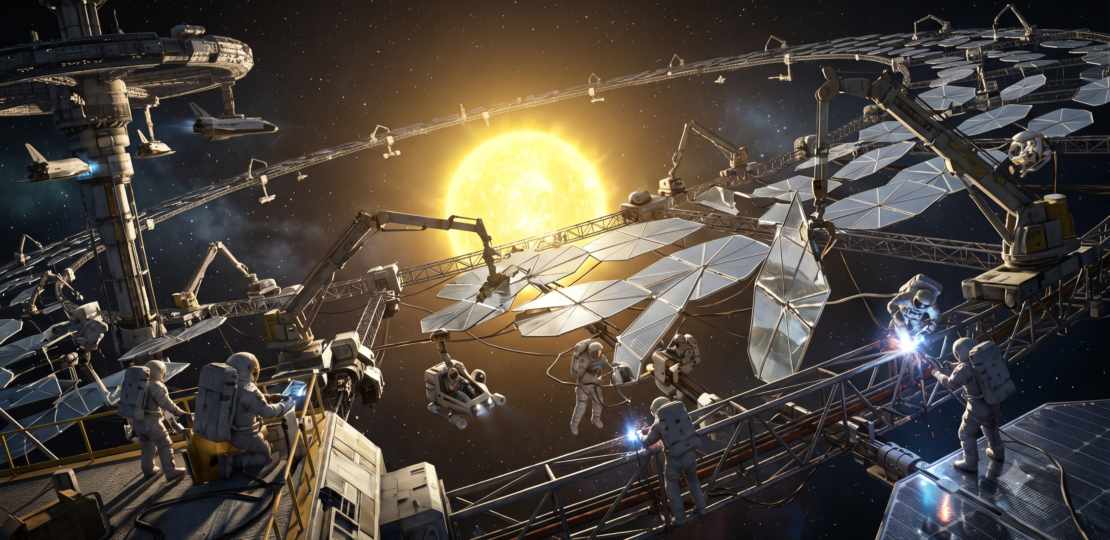
A Dyson swarm is often dismissed as a fantasy because of its immense scale. Yet history suggests that humanity rarely leaps directly to transformative technologies. Instead, progress comes from solving smaller problems that, in hindsight, become the foundations of something much larger. Surprisingly, many of those foundations are being laid today.
The greatest obstacle to a Dyson swarm has never been physics—it has been engineering. Launching millions of tons of material into orbit is prohibitively expensive, making reusable rockets one of the most significant advances in modern spaceflight. SpaceX’s Starship aims to reduce the cost of reaching orbit by orders of magnitude, while satellite constellations such as Starlink have demonstrated that spacecraft can be manufactured by the thousands rather than as bespoke machines. What once seemed unimaginable is slowly becoming an industrial process.
Other pieces of the puzzle are emerging as well. Space agencies and private companies are researching space-based solar power, in which satellites collect sunlight continuously and beam energy back to Earth. Meanwhile, companies like AstroForge are exploring asteroid mining, recognizing that any civilization hoping to build enormous structures in space will eventually need resources beyond Earth’s finite supply. Advances in autonomous robotics and in-orbit manufacturing point toward a future where spacecraft are assembled and maintained in space rather than launched fully built from the ground.
None of these projects are attempts to build a Dyson swarm, nor are they likely to become one anytime soon. Yet together they reveal something remarkable. Humanity is gradually developing the very capabilities that such a megastructure would require—not because we are pursuing a grand cosmic vision, but because each technology solves an immediate engineering problem. The path to building around a star, if it ever exists, may not begin with a master plan. It may begin with a reusable rocket, an autonomous satellite, and a factory quietly operating in orbit.
RELATED POSTS
View all