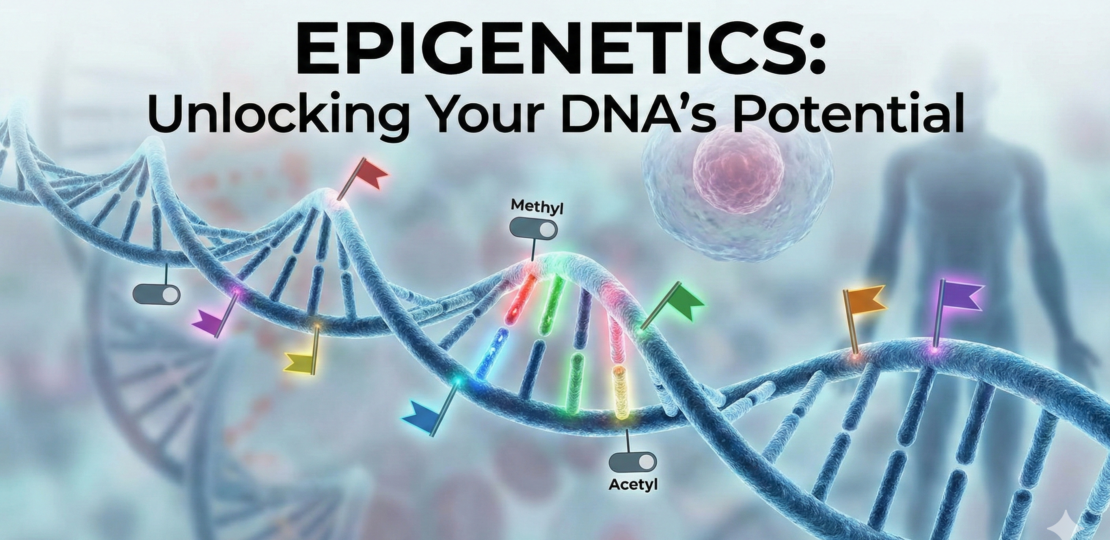
Every cell in your body carries essentially the same DNA, yet a neuron behaves nothing like a muscle cell, and a liver cell never forgets it is a liver cell. The mystery is not in the genetic code itself, but in how that code is read, silenced, or amplified. This is the realm of epigenetics—molecular marks layered on top of DNA that act like annotations in the margins of a book.
One of the most common epigenetic marks is DNA methylation, a small chemical tag added to specific DNA bases. These tags don’t change the gene’s sequence, but they strongly influence whether a gene is active or silent. Histone modifications work in a similar way. DNA is wrapped around proteins called histones, and chemical changes to these histones can tighten or loosen that wrapping. Tightly wrapped DNA is harder to read; loosely wrapped DNA is an open invitation for gene expression.
What makes epigenetics especially strange is its memory. When a cell divides, it copies not only its DNA but much of its epigenetic state as well. This allows patterns of gene expression to persist across generations of cells. In a sense, cells remember past decisions—what they once became, what they once silenced—even though they have no nervous system, no awareness, no brain.
This memory is flexible, but not infinitely so. Environmental factors like stress, nutrition, and toxins can alter epigenetic marks, sometimes with long-lasting effects. Yet most of these changes are reversible, which makes epigenetics both hopeful and unsettling. Biology is not a fixed script; it is a draft that can be edited, but never without constraints. At the molecular level, identity is less about what is written in DNA and more about what the cell chooses to reread—and what it quietly keeps closed.
RELATED POSTS
View all