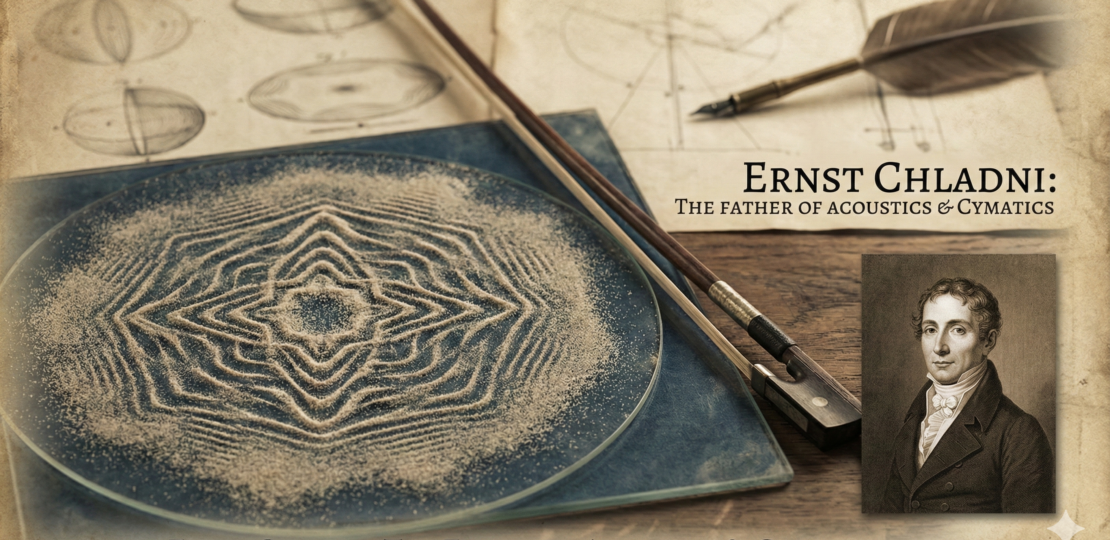
Picture a quiet room, a metal plate, and a man gently dragging a violin bow along its edge. Suddenly, the plate bursts into delicate patterns—stars, spirals, spiderweb-like lattices. It looks like magic, but it’s really sound, caught red-handed.
This was the daily life of Ernst Chladni, an 18th-century German physicist often called the father of acoustics. While most people were content to hear sound, Chladni wanted to see it. He sprinkled fine sand on metal plates and made them vibrate by bowing their edges, forcing the sand to dance into intricate shapes now known as Chladni figures. These patterns map out the nodes—places where the plate isn’t vibrating—and gave scientists their first visual clue to the behavior of waves.
It’s a wonderfully odd image: a man turning physics into performance art. Yet Chladni’s experiments weren’t just beautiful—they were groundbreaking. His work helped bridge music, physics, and engineering. Modern acoustics, speaker design, architectural soundproofing, and even the vibrational testing of spacecraft all trace their lineage back to those shimmering sand patterns.
Chladni’s curiosity didn’t stop at sound. He also studied meteorites at a time when most scientists thought rocks couldn’t possibly fall from the sky. He pushed back anyway, insisting on evidence over assumption, and helped shift scientific opinion. Not a bad side quest for someone who was basically doing physics calligraphy with sand.
His legacy sits in that delightful overlap between art and science. By making the invisible visible, Chladni reminded the world that even something as everyday as sound hides patterns and structures waiting to be revealed. It leaves you wondering what else around us whispers a secret shape—just waiting for someone unconventional enough to coax it out.
RELATED POSTS
View all