Every major leap in civilization has ultimately been a story of harnessing more energy. Fire transformed early humans. Steam powered the Industrial Revolution. Electricity connected the modern world. If this trend continues, the defining challenge of future civilizations may not be intelligence or computation, but energy itself.
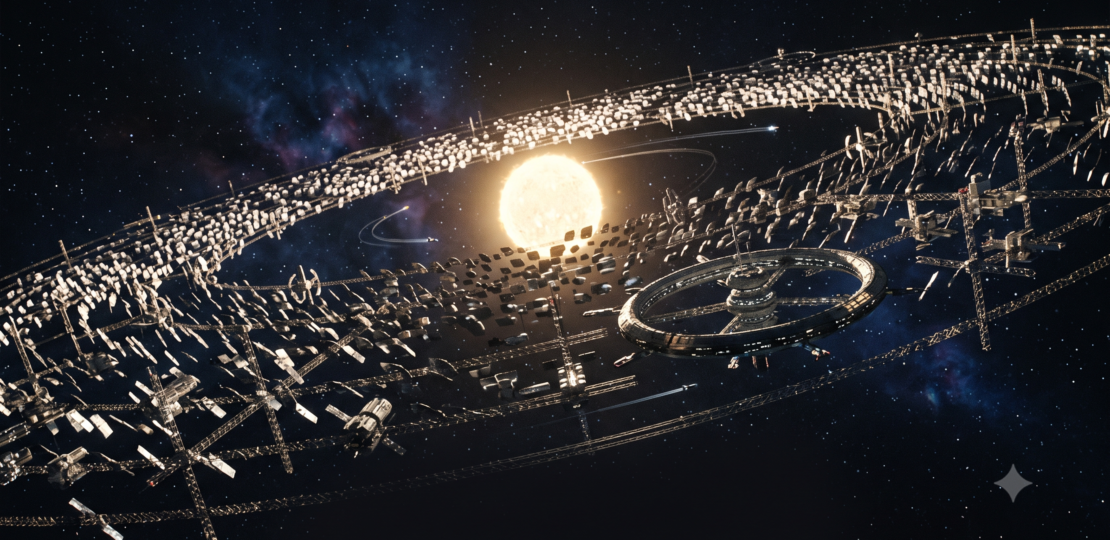
Our Sun produces roughly twenty trillion times more power than humanity currently consumes, yet almost all of that energy escapes into empty space. In 1960, physicist Freeman Dyson proposed a thought experiment: what if an advanced civilization didn’t rely on a single planet for energy? Instead, it could construct millions of solar-collecting satellites orbiting its star. Contrary to the popular image, Dyson never envisioned a solid shell around the Sun. Such a structure would be mechanically unstable and unimaginably difficult to build. A swarm of independent collectors, however, could grow gradually over centuries while harvesting an ever-larger fraction of the star’s energy.
The implications are extraordinary. A civilization with access to stellar-scale energy could power vast orbital industries, sustain habitats housing trillions of people, propel interstellar spacecraft, or operate computers beyond anything conceivable today. At that point, growth is no longer constrained by the resources of a single planet. The star itself becomes the civilization’s power source.
The Dyson swarm remains a thought experiment rather than an engineering proposal. Yet it represents something deeper than an ambitious megastructure. It asks a simple question: if technological progress always demands more energy, what is the logical endpoint? Perhaps the most advanced civilizations do not merely live around stars—they build around them.
RELATED POSTS
View all