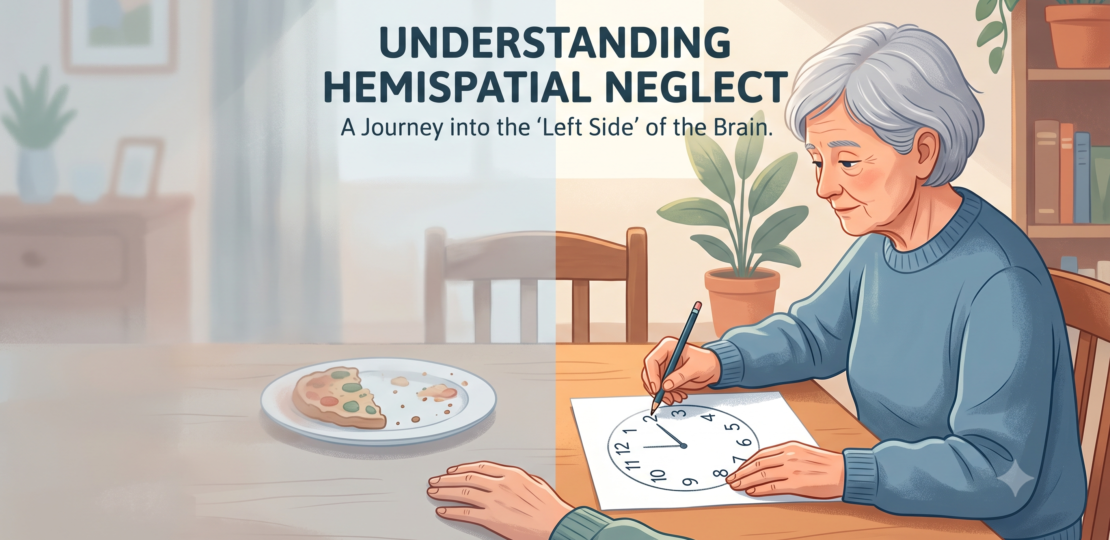
Imagine sitting down to eat dinner and only eating the food on the right side of your plate. Someone points to the untouched food on the left, but you insist the plate is empty. As strange as it sounds, this can happen. The condition is known as hemispatial neglect, a rare neurological disorder that most commonly occurs after a stroke affecting the brain’s right hemisphere. Despite having healthy eyes, individuals with the condition fail to attend to one side of the world—usually the left.
Hemispatial neglect is not a form of blindness. People with the condition can often move their eyes to the neglected side and, in some cases, identify objects if their attention is specifically directed there. The problem lies in the brain’s attention networks rather than the eyes themselves. Researchers have documented remarkable cases in which patients shave only one side of their face, apply makeup to only half of it, or draw a clock with every number crowded onto the right side.
One of the most famous demonstrations involved patients imagining themselves standing in a familiar city square. They described only the buildings on one side. When asked to imagine standing at the opposite end of the square, they described the buildings they had previously omitted while now neglecting the opposite side. The information still existed in memory—it simply wasn’t being attended to from a particular perspective.
The condition has fundamentally changed how neuroscientists think about perception. We often assume that seeing is a direct consequence of light entering the eyes. Hemispatial neglect suggests otherwise. Before information reaches conscious awareness, the brain decides what deserves attention. Vision alone is not enough; attention is an essential part of perception.
Although hemispatial neglect is rare, it reveals something universal about the human mind. Every second, the brain filters an overwhelming amount of sensory information, allowing only a fraction to reach conscious awareness. Most of the time, this process is invisible. Conditions like hemispatial neglect remind us that the world we experience is not simply what our eyes detect, but what our brain chooses to acknowledge.
RELATED POSTS
View all