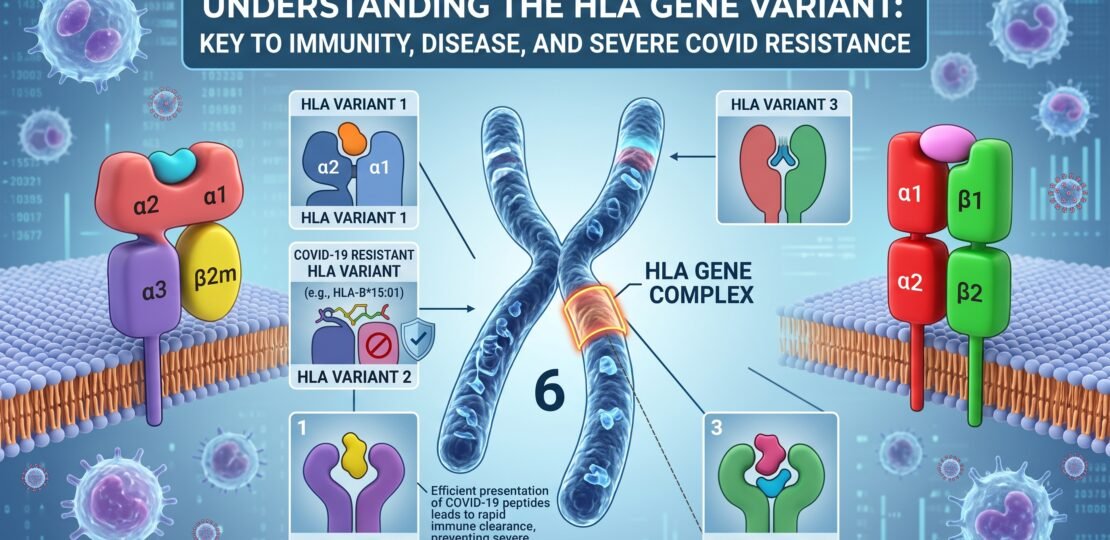
In 2020, researchers studying a small group of people who appeared unusually resistant to severe COVID-19 found an unexpected genetic clue. Some carried variants in a gene called HLA, part of the immune system’s machinery for recognizing infected cells.
HLA molecules display fragments of proteins on the surface of cells, effectively presenting pieces of what is happening inside the cell to immune cells. Certain HLA variants appear particularly effective at presenting fragments from SARS-CoV-2, allowing the immune system to recognize infected cells more quickly.
The important insight is that genetic differences do not necessarily determine whether someone becomes infected. They can instead influence how quickly the immune system recognizes the threat.
The HLA system is extraordinarily diverse. Thousands of variants exist in human populations, partly because different variants can recognize different collections of pathogens. A genetic variant that offers an advantage against one virus may provide little benefit against another.
This diversity is one reason genetic variation matters so much in infectious disease. Humanity does not possess a single immune system encoded by one universal genome. Instead, populations carry millions of genetic differences that collectively influence how bodies respond to biological threats.
A microscopic difference in DNA can therefore affect something tangible: how quickly a person’s cells recognize a virus.
The genome may be invisible, but its consequences are not.
RELATED POSTS
View all