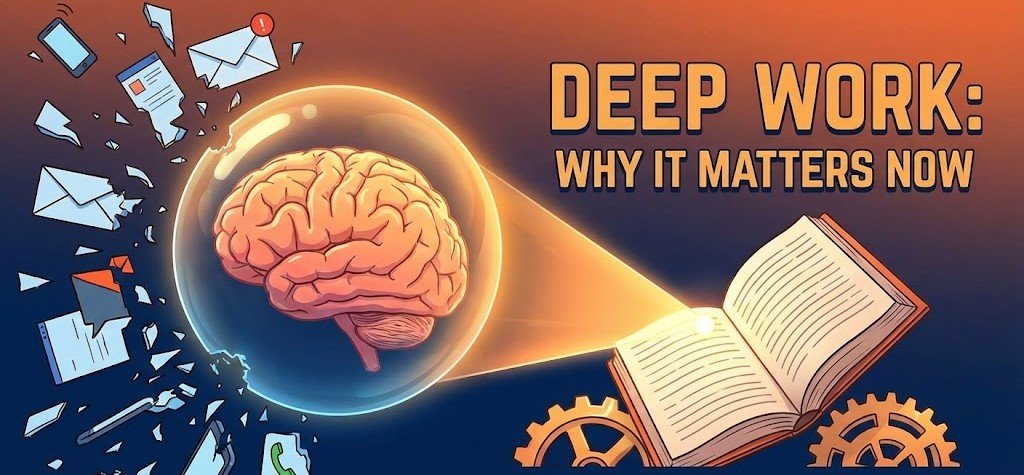
Welcome. This is a 5-part series in which I will explore the 4 types of deep work scheduling. Pick whichever might suit you at the end. Today, let’s talk about what deep work is.
Deep work is a term coined by Cal Newport (I’ve reviewed this book already. Check it out here.). It is a period of intense, distraction-free concentration on cognitively demanding tasks. Allow me to define what those tasks are first. There are two types of work/tasks you can do: deep work and shallow work. To explain with an example, deep work is you coding for a new app. It creates value, demands your attention, and is difficult to replicate. Shallow work, on the other hand, is creating a monthly report on your progress. It adds negligible value, you could do it while watching a show on the side, and you could hire and train a guy to do it easily. A more simplistic example is sending and answering emails. It is a logistical task, not a cognitively demanding task. Another key thing is these deep work tasks push you to your cognitive limits, meaning if it is effortless, it cannot be deep work; it’s usually a shallow task.
So why does it matter? In the modern world, both our work culture and lifestyle are immersed in distractions and shallow tasks. Constant notifications fragment your attention to the point that virtually none remain for tasks that actually matter. We don’t have to be bored, and without that mental stillness, creativity takes a severe hit. When you can passively consume to defeat idle attention, why bother formulating novel insights? Moreover, we find ourselves increasingly becoming knowledge workers rather than physical laborers, meaning you have nothing but value added to show for your efforts. At precisely the moment it is becoming valuable, deep work is growing increasingly scarce.
So what does deep work do? Deep work teaches you to focus. Focus is a cultivated skill developed into a habit, not a trait generated by birth. Once you can work deeply, you’ll find yourself going into the flow state, where time is nonexistent and the work just pulls you in. The advantage is, you’ll be disproportionately more productive than ever before. People have done twice as much work as before in the same span of time by embracing deep work.
Now, the way of deep work varies person to person, depending on career paths, commitment, phase of life, etc. However, they usually fall into 4 philosophies: Monastic, Bimodal, Rhythmic or Journalistic. Let’s explore them one by one in the coming days. Signing off for now.
RELATED POSTS
View all