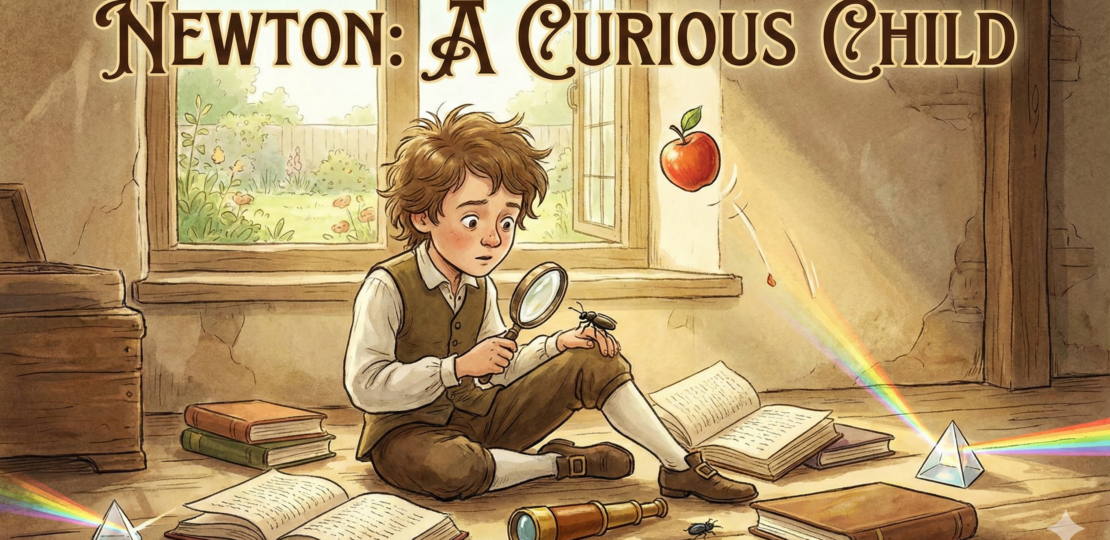
Isaac Newton, one of history’s most influential scientists, was born on January 4, 1643, in Woolsthorpe, Lincolnshire, England. His birth was a precarious one: he was premature and weak, and his father had died three months earlier. Newton’s early childhood was marked by hardship, as his mother remarried and left him in the care of his grandparents. Despite this difficult upbringing, Newton displayed an extraordinary curiosity about the natural world from an early age. He often dismantled clocks and other mechanical objects, fascinated by how things worked.
School life introduced him to mathematics and the classical sciences. While Newton wasn’t initially a standout student, he gradually developed a methodical and analytical mind that would later underpin his revolutionary work. Teachers noted his obsession with experiments and his ability to focus intensely on solving problems. By the time he reached the grammar school in Grantham, Newton had already begun cultivating habits of careful observation and meticulous record-keeping that would define his scientific method.
Beyond formal education, Newton’s childhood interests were practical as well as intellectual. He experimented with lenses, prisms, and other objects, exploring light, reflection, and refraction. These early experiments foreshadowed his later groundbreaking work in optics. It was not uncommon for him to spend hours alone in his room, fully absorbed in observation and thought, demonstrating a precocious ability to learn independently.
Newton’s formative years were also shaped by the tumultuous backdrop of 17th-century England. The English Civil War and subsequent political instability had a profound influence on the culture of learning, encouraging self-reliance and intellectual curiosity. Newton’s perseverance, despite personal and societal challenges, laid the foundation for his later achievements in mathematics, physics, and astronomy.
By the end of his childhood, it was clear that Isaac Newton was no ordinary boy. His fascination with the workings of the natural world, combined with a keen intellect and unrelenting curiosity, set him on a path toward the discoveries that would forever change humanity’s understanding of the universe.
RELATED POSTS
View all