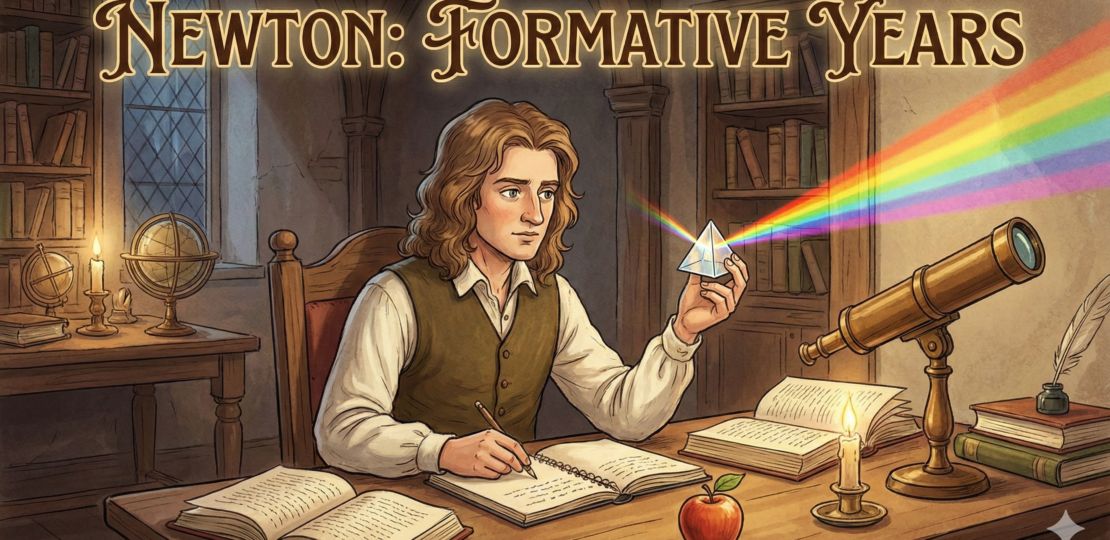
In 1661, Isaac Newton entered Trinity College, Cambridge, where he would immerse himself in the works of classical scholars and contemporary thinkers. The curriculum was heavily focused on Aristotelian philosophy and the mathematics of Euclid, but Newton’s true interests lay in the emerging scientific ideas of the time. He was particularly influenced by the works of Galileo, Descartes, and Kepler, whose observations of motion and planetary systems challenged traditional ideas.
During this period, Newton began developing his own theories. His approach was highly methodical: he would observe, experiment, and record results meticulously. It was in this environment that Newton began working on optics, conducting experiments with prisms to study the nature of light. He demonstrated that white light was composed of a spectrum of colors, a discovery that challenged centuries of accepted thought and showcased his experimental rigor.
Mathematics became another arena for Newton’s genius. He independently developed the foundations of calculus—though the credit was later controversially shared with Gottfried Wilhelm Leibniz. His calculus work allowed him to describe change and motion with unprecedented precision, laying the groundwork for his laws of motion. This period at Cambridge also fostered his interest in gravitation, mechanics, and the broader physical laws that govern the universe.
Newton’s studies were interrupted in 1665 by the Great Plague, which closed the university. He returned to Woolsthorpe, where he experienced a prolific period of reflection and experimentation known as his “Annus Mirabilis,” or “Year of Wonders.” During this time, he formulated his theories of motion, gravitation, and the beginnings of what would become his monumental work, Philosophiæ Naturalis Principia Mathematica. The isolation forced him to think deeply, experiment freely, and synthesize knowledge in ways impossible within the structured university environment.
These formative years reveal Newton not merely as a scholar but as a revolutionary thinker. His combination of meticulous experimentation, theoretical insight, and innovative mathematics set the stage for a scientific revolution. It was here, in relative obscurity and intellectual solitude, that Newton began shaping ideas that would redefine humanity’s understanding of the cosmos.
RELATED POSTS
View all