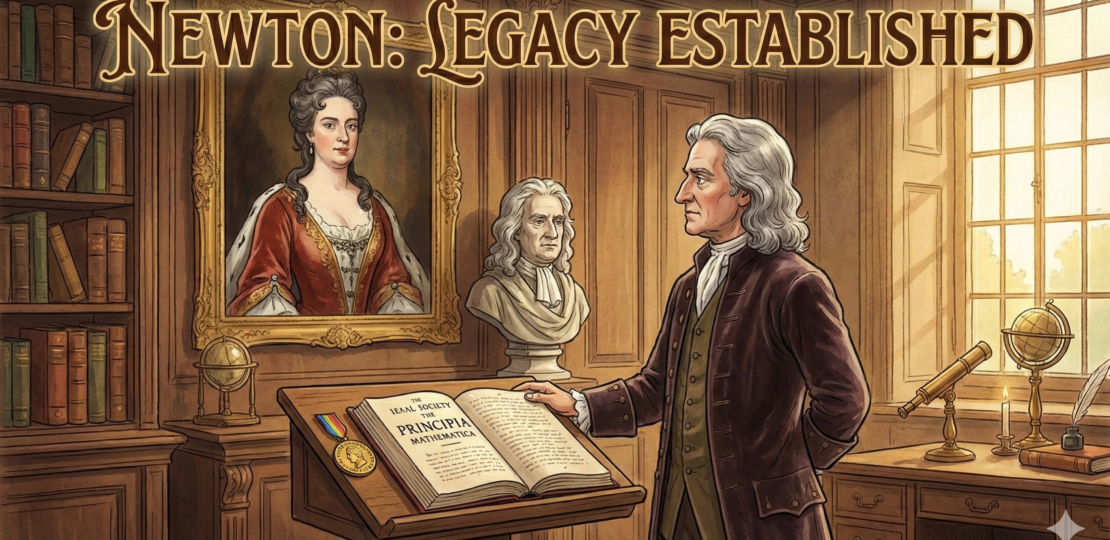
Isaac Newton’s contributions to science culminated in the publication of Philosophiæ Naturalis Principia Mathematica in 1687, often referred to simply as the Principia. In this work, he formulated the three laws of motion and the universal law of gravitation, providing a comprehensive framework to describe the behavior of objects both on Earth and in space. Newton’s laws not only explained why planets orbit the sun but also allowed for precise predictions of physical phenomena, bridging the gap between theory and observation.
Newton’s genius extended beyond physics. His research in optics led to the development of the reflecting telescope, an instrument that reduced chromatic aberration and enhanced astronomical observation. He also investigated the nature of light and color, using prisms to demonstrate that white light could be separated into a spectrum and recombined—a fundamental insight into the behavior of light. His work in mathematics, including the invention of calculus, became the essential language of science, enabling future generations to describe and predict complex systems.
Newton’s influence extended into his role as a public intellectual and academic leader. He became Lucasian Professor of Mathematics at Cambridge, and later, Warden and Master of the Royal Mint. His work at the Mint showcased his analytical rigor and integrity, particularly in combating counterfeiting. Newton’s meticulous approach to problems, whether in theoretical science or practical administration, reflected a mind capable of extraordinary precision and dedication.
Despite his achievements, Newton was a private and sometimes contentious figure. He had intense rivalries with contemporaries, including Robert Hooke and Leibniz, and could be fiercely protective of his discoveries. Yet, his intellect was matched by an unwavering curiosity, a relentless pursuit of truth, and an ability to see the universe in fundamentally new ways. His life exemplifies how solitary thought, disciplined experimentation, and deep contemplation can yield insights of lasting impact.
Newton’s legacy continues to shape the modern world. From the principles of motion that underpin engineering and space travel to the mathematical tools that allow us to model complex phenomena, his work remains a cornerstone of science. Isaac Newton did not merely discover the laws of the universe; he taught humanity how to think about it—logically, experimentally, and boundlessly.
RELATED POSTS
View all