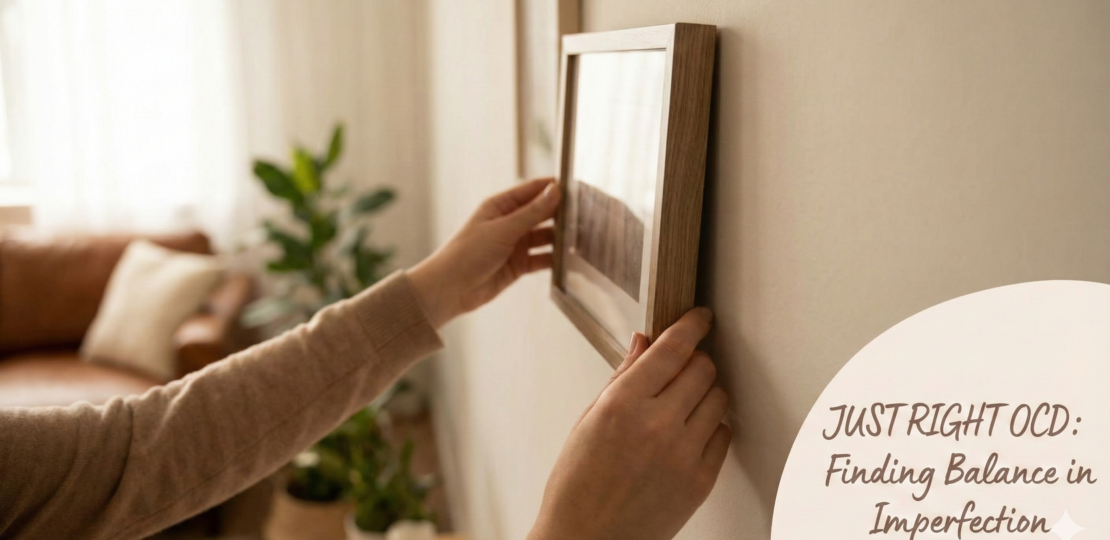
Most people imagine OCD as endless handwashing or a fear of germs, but there’s a quieter, more psychologically intricate variant called “just-right” OCD. It’s less about fear of contamination and more about the visceral discomfort of things feeling wrong. The trigger isn’t danger—it’s imperfection. A book slightly tilted on a shelf, a sentence that “doesn’t sound right,” the sensation of walking through a doorway at the wrong moment—these tiny misalignments can set off an internal alarm that won’t shut up until the moment feels correct again.
This form of OCD creates a paradox in the mind: the person often knows the fear is irrational, yet the discomfort is real enough to override logic. Researchers describe it as a miscommunication between sensory processing regions and the brain’s error-detection system. That system, which normally alerts us to genuine problems, becomes hypersensitive. It rings the bell not only for fires but for slightly crooked picture frames. The brain keeps whispering: Fix it. Do it again. It isn’t right yet. The whisper can grow into a command that loops until the person “resets” the moment in a way that finally satisfies the mind’s unseen criteria.
What makes this disorder so draining is its demand for precision in a world that almost never cooperates. Everyday tasks—tying shoelaces, writing a paragraph, locking a door—can stretch into elaborate rituals. It’s not about achieving external perfection; it’s about calming an internal tension that flares for reasons even the person can’t explain. Many describe the sensation as a kind of mental itch, something that can’t be ignored until scratched.
“Just-right” OCD highlights how much of our mental life depends on the fragile harmony between sensation and emotion. Most people feel minor irritations fade within seconds; the world’s asymmetry is tolerable. But when this system goes awry, the ordinary becomes overwhelming. It’s a reminder that the mind isn’t just thinking—it’s constantly judging, comparing, and fine-tuning the world to match its internal map. Illuminating disorders like this doesn’t only teach us about pathology; it gently reveals how all of us rely on invisible calibrations to feel settled in our own skin.
RELATED POSTS
View all