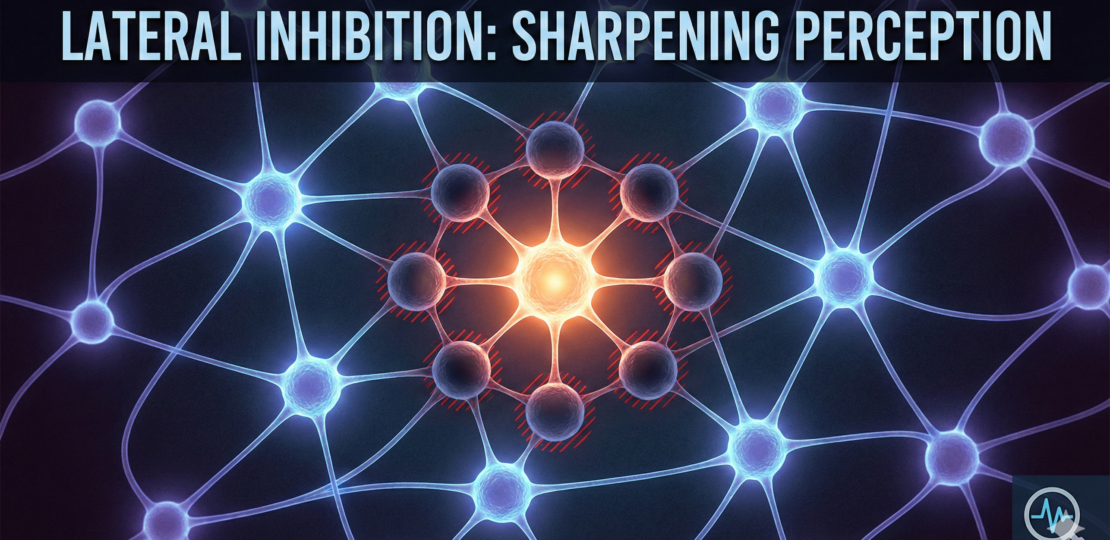
Your nervous system does something slightly sneaky. It exaggerates differences.
This process is called lateral inhibition. It happens when a stimulated neuron reduces the activity of its neighboring neurons. In simple terms, when one signal fires strongly, it tells its neighbors to quiet down. The result? Edges become sharper. Contrast becomes stronger. The world looks clearer than the raw data actually is.
The classic example happens in your retina. Light hits photoreceptors, which activate neurons that send signals to the brain. But those neurons also inhibit nearby cells. At boundaries—say, where a bright surface meets a dark one—the contrast is amplified. Your brain highlights the edge. That’s why certain optical illusions create exaggerated brightness bands that aren’t physically there. Your visual system is enhancing contrast to help you detect structure.
From an evolutionary perspective, this is brilliant. Detecting edges quickly helps identify predators, obstacles, and movement. A slightly exaggerated world is more useful than a perfectly faithful one. Accuracy is less important than survival efficiency.
Now here’s the philosophical twist. Lateral inhibition isn’t unique to vision. Similar contrast-enhancing dynamics show up in other sensory systems—and even in social cognition. We notice extremes more than gradients. Strong opinions suppress moderate nuance. Emotional highs can mute subtle feelings. The nervous system, at many levels, seems wired to detect difference rather than smooth continuity.
Reality, as experienced, is partly sharpened by subtraction. Your brain doesn’t just report what is there—it enhances contrast to make meaning pop. The world you see isn’t raw photons. It’s a carefully exaggerated draft, optimized for survival rather than perfect objectivity. And once you realize that, every sharp edge in perception becomes a little more mysterious.
RELATED POSTS
View all