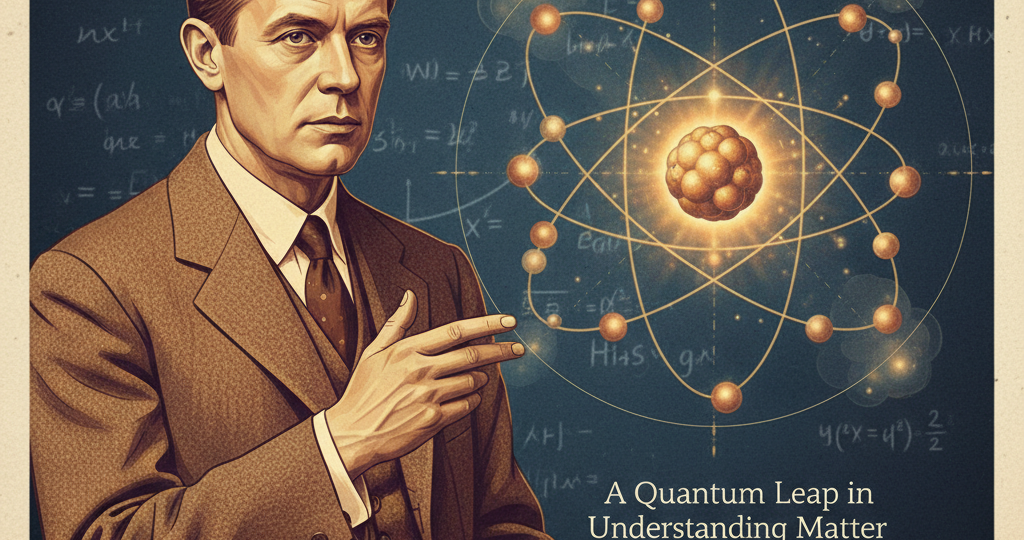
Have you ever looked at an atom (figuratively) and thought, “What’s going on in there?” Most of us haven’t — and that’s exactly why Niels Bohr became a legend. This Danish physicist didn’t just study atoms; he gave them a personality, a set of rules, and even a little drama that still shapes how we understand matter today.
Bohr is best known for the Bohr model of the atom. Imagine electrons not just floating randomly, but orbiting the nucleus in neat energy levels — kind of like planets around the sun, except tinier and way faster. Before Bohr, atoms were mysterious, fuzzy blobs. His model gave structure, predictability, and a way to explain why atoms emit light in colorful lines instead of one dull glow.
But Bohr didn’t stop at diagrams. He pioneered the principle of complementarity, a mind-bending idea that particles can behave like waves or particles depending on how you observe them. In simpler terms: the universe sometimes refuses to give you straight answers, and you have to accept multiple realities at once. Bohr’s thinking laid the foundation for quantum mechanics, influencing giants like Heisenberg and Schrödinger.
Outside the lab, Bohr was a master of diplomacy and mentorship. He helped refugee scientists escape Nazi-occupied Europe and fostered a generation of physicists who would shape the 20th century. With his gentle wit and relentless curiosity, Bohr showed that even the smallest particles could tell the biggest stories — if only you asked the right questions.
RELATED POSTS
View all