Imagine a heavy nucleus as a slightly overstuffed water balloon. Not a solid billiard ball — more like a droplet held together by surface tension. That picture isn’t poetic exaggeration. Physicists actually model heavy nuclei using something called the liquid drop model.
The idea is simple: protons and neutrons behave collectively, almost like molecules in a tiny drop of incompressible fluid. The strong nuclear force acts like surface tension, holding the drop together. Meanwhile, the positive charges of the protons repel each other, trying to stretch it apart.
Most of the time, the nuclear “surface tension” wins. But in very heavy nuclei like uranium, the electrical repulsion is enormous. The drop is already under stress.
Now introduce a neutron.
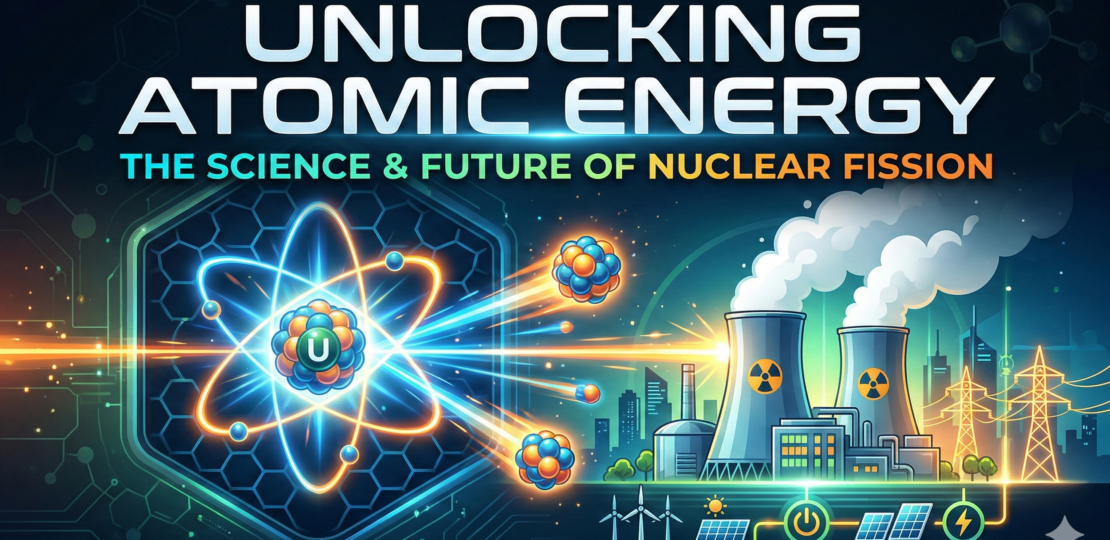
Unlike a proton, a neutron carries no electric charge. So it can slip into a heavy nucleus without being repelled. When uranium-235 absorbs a neutron, it becomes unstable. The added energy makes the nucleus vibrate — and this is not a gentle vibration. The droplet elongates. It stretches into a peanut shape. The electrical repulsion between protons increases as they move farther apart.
If the deformation crosses a certain threshold, the surface tension can’t pull it back. The nucleus splits.
That’s nuclear fission.
When it splits, it doesn’t break neatly in half like snapping a stick. It divides into two medium-sized nuclei, plus a few extra neutrons, plus a tremendous amount of energy. That energy comes from binding energy — the difference in how tightly nucleons are held together before and after the split.
Here’s the subtle but crucial point: medium-sized nuclei are more tightly bound per nucleon than very heavy ones. So when a heavy nucleus splits into smaller ones, the total binding energy increases. Nature prefers tighter binding. The excess energy is released as kinetic energy of the fragments and radiation.
One fission event is tiny. But each split releases additional neutrons. Those neutrons can trigger more fissions. If each event triggers, on average, more than one additional event, you get a chain reaction.
Controlled chain reaction? Nuclear power plant.
Uncontrolled chain reaction? Nuclear explosion.
Same physics. Different engineering.
What fascinates me is how delicate the balance is. A heavy nucleus is not inherently explosive. It sits there peacefully for millions of years. But introduce the right perturbation — one stray neutron — and the internal tension becomes catastrophic. Stability gives way to fragmentation.
And yet this destructive process powers cities. It also powers stars indirectly through the physics of binding energy. The same fundamental curve of nuclear stability governs both the warmth in your home and the violence of supernovae.
The nucleus is not a static object. It is a dynamic system perched between cohesion and rupture. Push it just slightly beyond its comfort zone, and it reveals how much energy was quietly stored inside all along.
Matter looks calm. Inside, it is negotiating forces powerful enough to reshape worlds.
RELATED POSTS
View all

The Parker Solar Probe – Humanity’s Closest Encounter with the Sun
February 28, 2025 | by Venkat Balaji