Every mission beyond Earth’s orbit faces the same problem: rockets must carry nearly all of their fuel from launch. This creates an unforgiving cycle. More fuel requires a larger rocket, which in turn requires even more fuel to lift that extra weight. Engineers refer to this as the tyranny of the rocket equation, and it is one of the greatest obstacles to deep-space exploration.
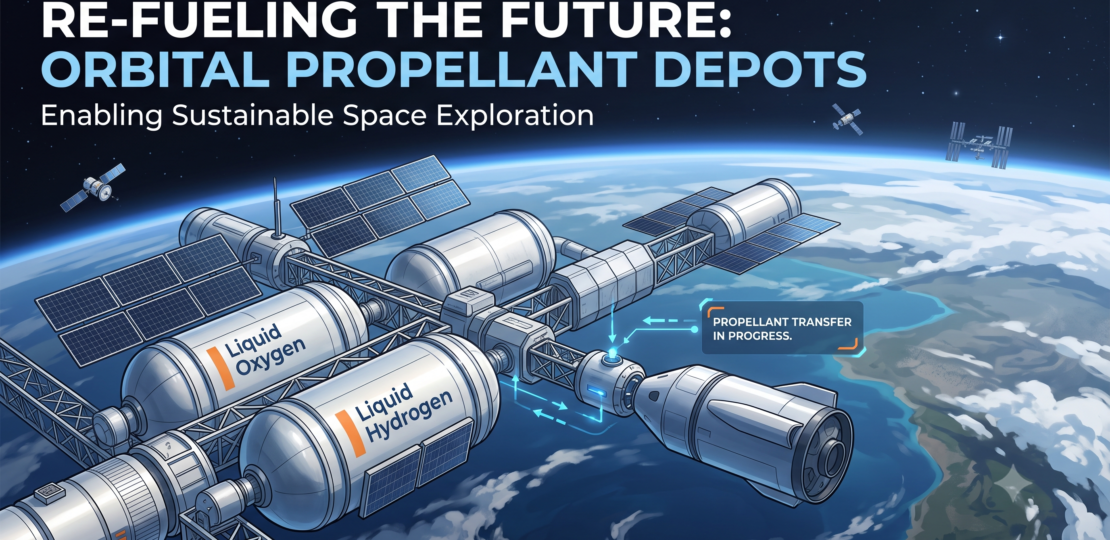
Rather than building ever-larger rockets, some engineers are pursuing a different strategy: orbital propellant depots. These would function much like fuel stations in space, storing cryogenic propellants such as liquid hydrogen and liquid oxygen in orbit. A spacecraft heading to the Moon or Mars could launch with only enough fuel to reach the depot, refill its tanks in space, and then continue its journey. This approach could dramatically reduce launch costs while allowing spacecraft to be designed for missions far beyond Earth’s orbit.
Building such a network is far from simple. Liquid hydrogen must be kept at temperatures below –253°C, making long-term storage one of the most difficult cryogenic engineering challenges ever attempted. Engineers are developing advanced insulation systems, zero-boil-off cooling technologies, autonomous docking mechanisms, and techniques for transferring liquids in microgravity without relying on gravity to settle the fuel. NASA has studied orbital fuel depots for years, and companies such as SpaceX have demonstrated in-orbit propellant transfer—a critical step toward making them practical.
The significance of orbital fuel depots extends well beyond a single technology. Airports transformed aviation not because airplanes changed, but because a supporting infrastructure emerged around them. Likewise, humanity’s future in space may depend less on building bigger rockets and more on constructing the logistical network that makes routine travel possible. Before there are cities on Mars, there may first be something far less glamorous—but arguably more important: a gas station quietly orbiting Earth.
RELATED POSTS
View all